Two University of Victoria (UVic) researchers in the Faculty of Engineering and Computer Science have received a combined $5.43 million in funding from the federal government’s regional development agency for British Columbia to strengthen space, climate and dual-use technologies with real-world impact across Canada.
Pacific Economic Development Canada’s (PacifiCan) investment supports next steps in scaling research excellence and expertise, says Lisa Kalynchuk, vice-president research and innovation at UVic.
“UVic research in aerospace is advancing technologies that support small- and medium-sized businesses here in Canada,” says Lisa Kalynchuk, UVic vice-president of research and innovation. “Our partnerships create new ways to monitor the environment and support solutions for the safety and security of communities.”
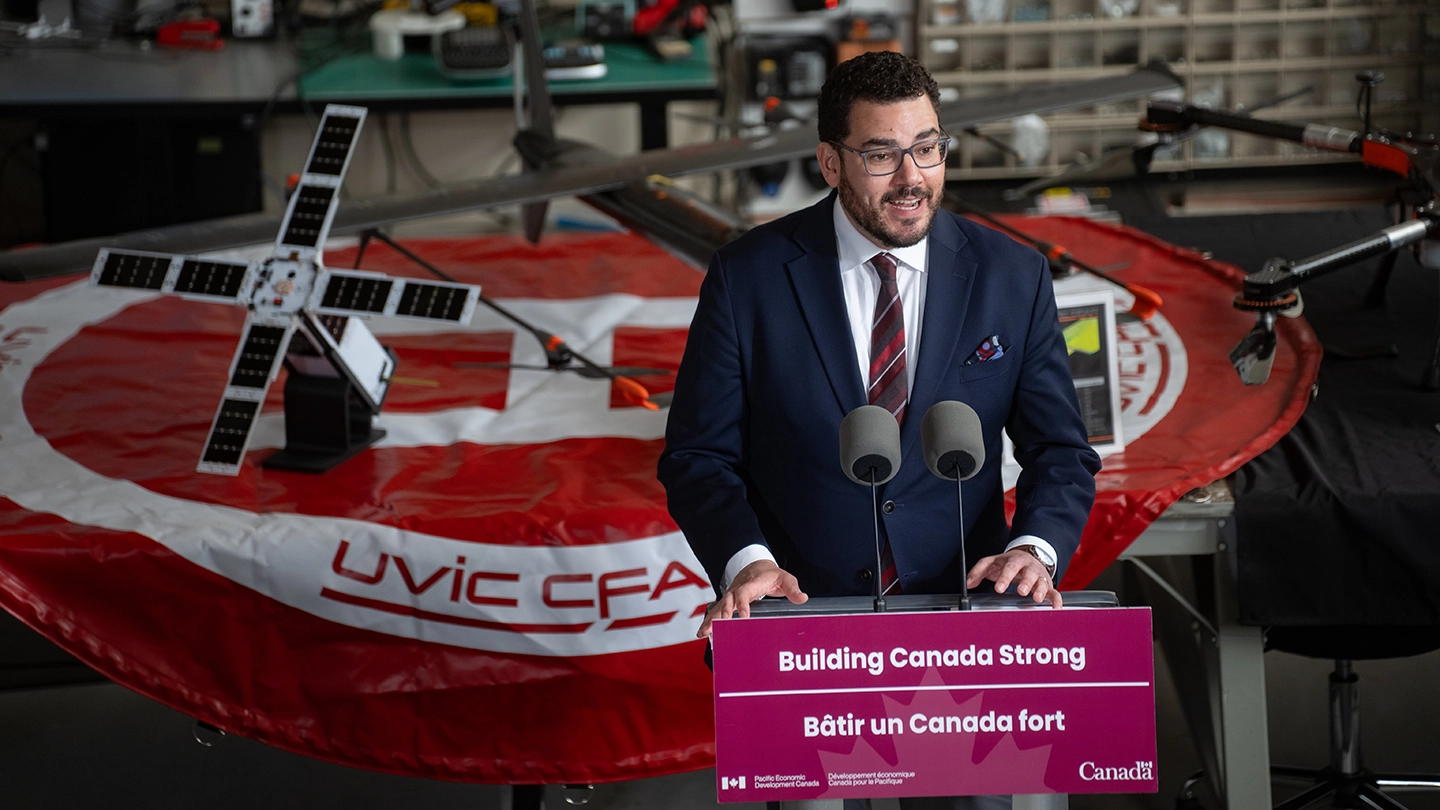
PacifiCan is investing $4 million to establish a Western Canada cluster focused on space-enabled industries. Led by Afzal Suleman, director of the Centre for Aerospace Research (CfAR), the project builds on CfAR’s track record of aerospace innovation including the launch of BC’s first CubeSat satellite, its aerospace systems engineering master’s program and a demonstrated commitment to local and global partners. The initiative will help the West Coast space industry and companies develop, test, and bring space technologies to market.
The project will give small- and medium-sized businesses access to specialized infrastructure, such as satellite ground stations and spacecraft testing facilities, as well as secure satellite data, applied research expertise and skilled personnel. By strengthening local supply chains and reducing reliance on overseas technologies, the cluster will support industries working in clean energy and agriculture, dual-use defense, uncrewed systems, marine technology, robotics and natural resources.
The project will foster stronger links between researchers and industry to create new opportunities for students, innovation and economic growth.
“This investment allows us to move beyond individual projects to build a strong, inclusive space innovation community,” says Suleman. “By connecting industry with local talent, infrastructure, and satellite data, we can bring new technologies to market and strengthen Canada’s economic resilience and sovereignty in space.”
The investment also supports research led by Homayoun Najjaran, head of UVic’s Advanced Control and Intelligent Systems Lab. Najjaran’s team has received $1.43 million to advance an AI-enabled drone surveying and mapping system designed to improve flood and wildfire risk assessment.
The autonomous system uses AI-driven data collection and analysis to deliver centimetre-scale mapping accuracy—capturing detail on the ground within one to five centimetres—that significantly improves existing hazard maps, while reducing costs and removing the need for on-site technical specialists. The technology will support land-use planning, housing development, infrastructure monitoring, and emergency response, particularly for smaller and remote communities, including Indigenous communities. Beyond civilian applications, the same capabilities have implications for defence, such as monitoring remote borders, and supporting situation awareness in vast areas.
“Accurate, affordable, and sovereign solutions for data collection and analytics are increasingly critical, whether for communities managing climate risk or for operations in remote areas or extreme environments,” says Najjaran. “This technology is designed to close that gap.”
Together, these projects reflect UVic’s strength in applied, interdisciplinary research that bridges engineering, artificial intelligence, sustainability, industry engagement and community collaboration.
“These investments demonstrate how university research can drive innovation, commercialization, and public benefit at the same time,” says Colin Bradley, the faculty’s acting dean. “They also create hands-on opportunities for students and emerging researchers to develop the expertise needed to lead the next generation of aerospace and climate technologies.”
Learn more about Suleman: How UVic is shaping aerospace engineering technologies
Learn more about Najjaran: Teaching drones to think: UVic’s AI-powered aerial mapping system
Read the PacifiCan news release.