
A Canada-Spain partnership to monitor the Southern (Antarctic) Ocean has doubled its data capture capacity with the deployment of two new Ocean Networks Canada (ONC) subsea observatories, helping to address a data shortage gap in a rapidly changing part of the planet.
The two observatories were deployed this month offshore of the Spanish Antarctic Base (BAE) Juan Carlos I, by polar monitoring partners, ONC, an initiative of the University of Victoria, and the Spanish National Research Council (CSIC). The observatories near real-time data can be viewed on this data dashboard and on the ONC’s open online portal, Oceans 3.0, allowing scientists to track environmental change even when the seasonal base is unstaffed.
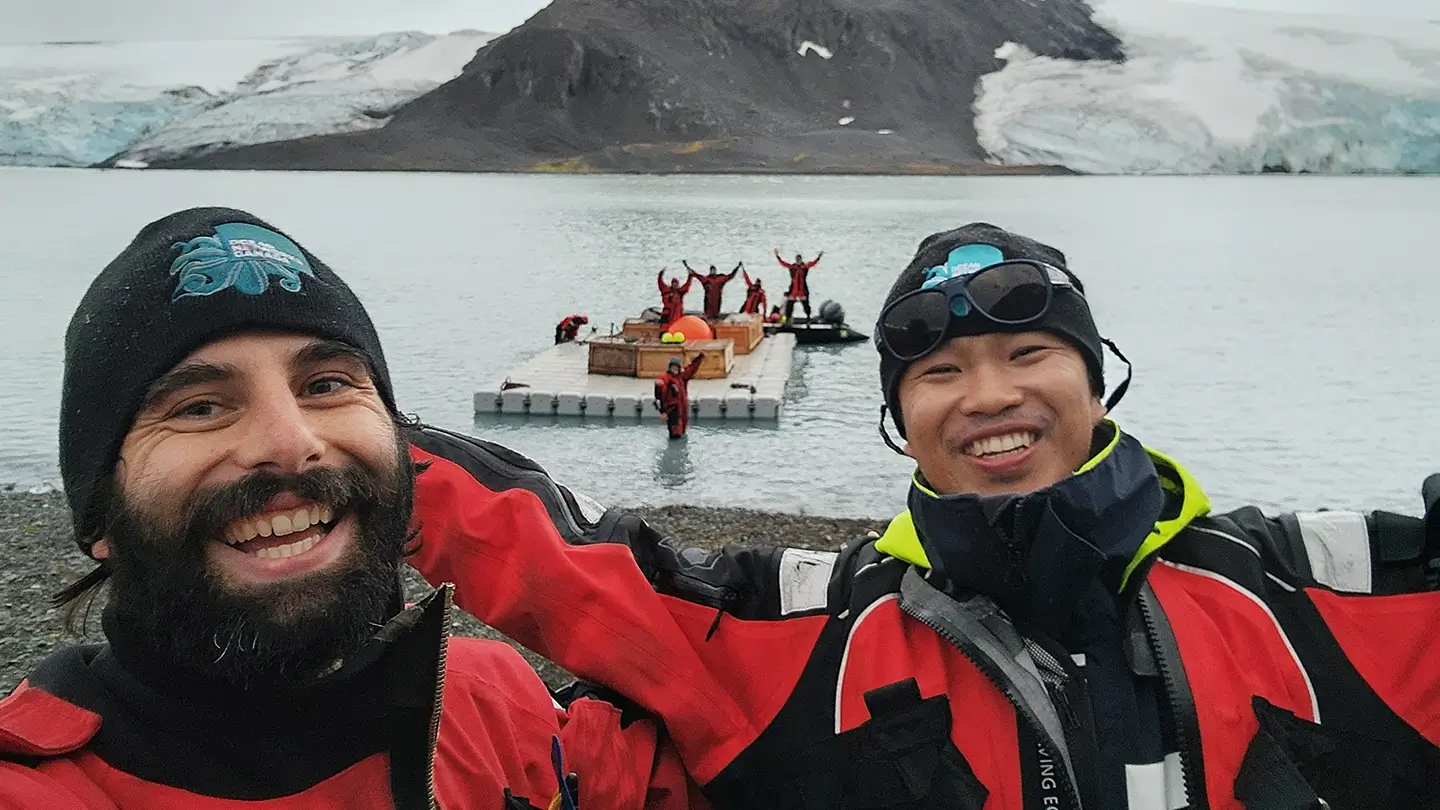
The installation was carried out by ONC Marine Technology Centre staff Ruchie Custan and Bradley Wells, who travelled from Victoria, BC to the base on Livingston Island in the South Shetlands Archipelago, to work alongside the Unit of Marine Technology of the CSIC (UTM-CSIC). Together they replaced an existing observatory and activated a second unit (after identifying a prime location), to double monitoring coverage.
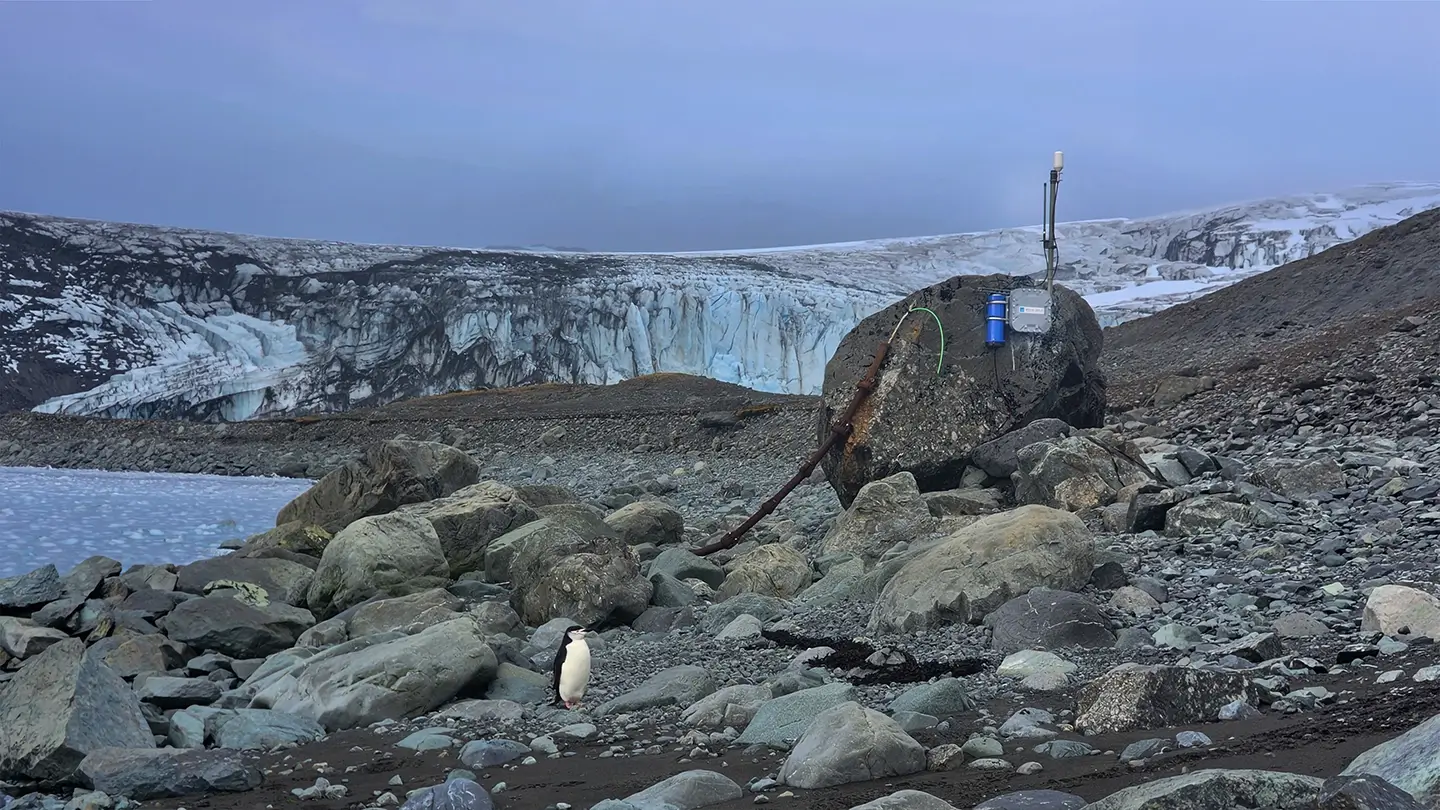
A key challenge for the teams developing these pioneering observatories was resolving some interruptions in data flow caused by large ice movements that had affected the original ONC-CSIC observatory installed in 2024 and its successor.
ONC marine equipment specialist Ruchie Custan says the cabling and the housing are now even better protected with a cast-iron split pipe to shield the system from moving ice, among other upgrades.
“Data are now also backed up through a radio-frequency link to the Spanish station, in addition to transmission via the existing Iridium satellite connection,” says Custan. “The new design features aim to enhance durability and reliable data delivery in the harsh Antarctic conditions.”
Each observatory has an ONC-designed shore station for data processing and transmission that is connected to a CTD instrument that takes hourly measurements of conductivity (salinity), temperature, depth (pressure), and dissolved oxygen levels, revealing physical and chemical ocean properties.
Both observatories are in Johnsons Dock, an adjoining bay to the research base, where glacier melt meets ocean waters. Wearing immersion suits for protection in the frigid waters, the teams installed the first observatory at a depth of 22 metres, and the second in roughly 20 metres of water, five metres below the surface.
ONC President and Chief Executive Officer Kate Moran says this positioning allows scientists to study how glacier and seawater mixing impacts the water at different depths. “Sea ice that surrounds the continent has seen large decreases over the past five years making it most important that we understand the changing ocean environments that are impacted by this loss of ice,” she says.
Juanjo Dañobeitia, one of the original visionaries behind the observatory partnership and a professor of marine geophysics at the CSIC, says international collaborations in Antarctica are advancing our knowledge of Earth’s dynamics.
“Understanding the Southern Ocean is essential for regulating Earth’s climate. The new underwater observatories located at two sites monitors some Essential Ocean Variables (EOVs) and transmits real-time data year-round, providing invaluable information on glacial melt and the health of marine ecosystems,” says Dañobeitia.
EOVs are a prioritized set of physical, biogeochemical, and biological measurements defined by the Global Ocean Observing System (GOOS) to monitor ocean health, climate change and biodiversity.
Bradley Wells, ONC project engineer (EIT), says favourable tides, winds, and wave conditions enabled the deployments from the floating dock — but it was exceptional teamwork that made them possible. “We are fortunate to have a partner like UTM-CSIC. The support, hard work and brainstorming at the base made this success possible. It feels great to have pulled it off,” he adds.
This research was supported by the Canada Foundation for Innovation Major Science Initiative Fund, in addition to other funding. It aligns with United Nations Sustainable Development Goal 14 (life below water).
About Ocean Networks Canada
Ocean Networks Canada (ONC) operates world-leading observatories in the deep ocean and coastal waters of the Pacific, Atlantic, and Arctic coasts of Canada as well as the Southern Ocean, collecting ocean data that accelerates scientific discovery and makes possible services and solutions for a resilient planet. ONC’s cabled observatories supply continuous power and Internet connectivity to scientific instruments, cameras, and 12,000-plus ocean sensors. ONC also operates mobile and land-based assets, including coastal radar. ONC is an initiative of the University of Victoria and is one of Canada’s Major Research Facilities.
A media kit containing videos, images and a map is available in this folder.
View this news release with a data dashboard on the ONC website.