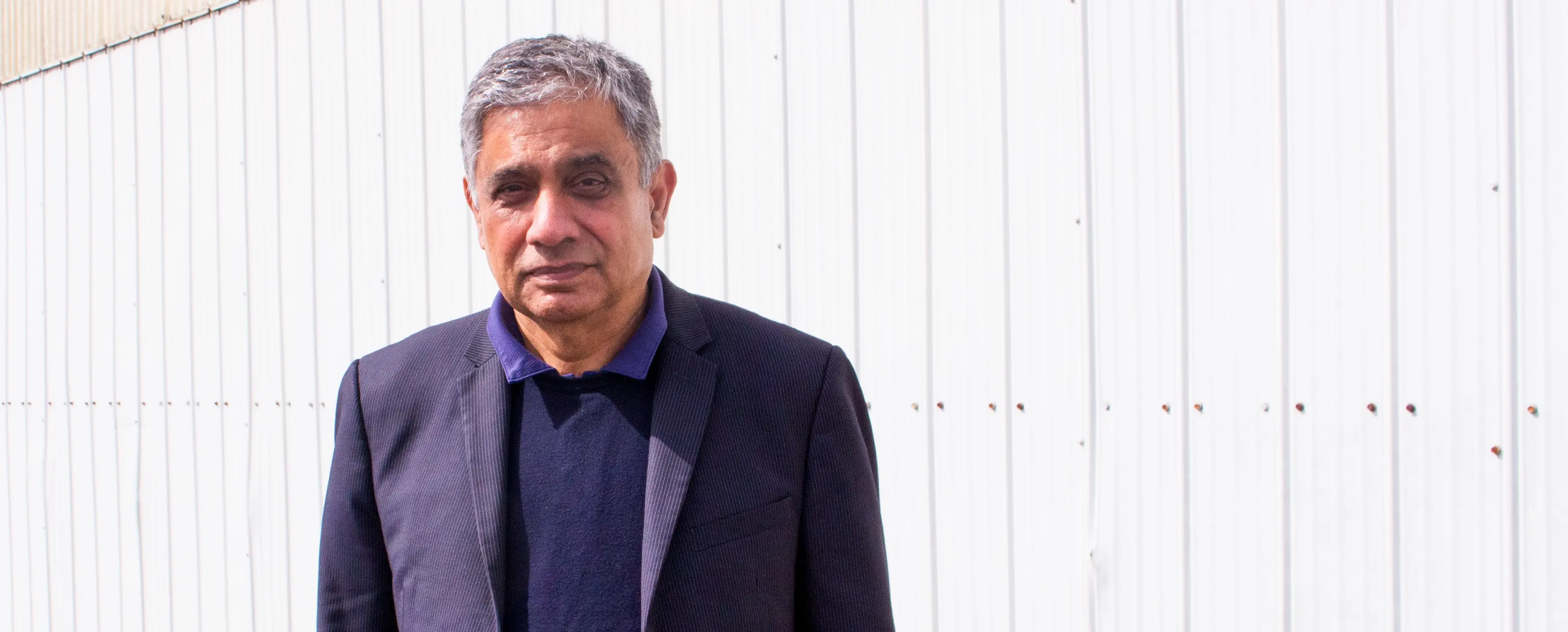
Spanning three continents and more than five decades, Afzal Suleman’s life and career have been propelled by the recognition, vision and encouragement of others.
It began with a high school math teacher in the United Kingdom who suggested he go into aerospace engineering. Then, a Canadian professor who met him at an international conference in Sweden and invited him to do his PhD in BC.
Later, colleagues in governments and air forces in Europe and North America pushed him to work on fighter jet and drone technologies and develop university courses in space and aircraft engineering.
For the last 25 years at the University of Victoria (UVic), Suleman has been paying forward all that inspiration and support—mentoring and supervising students who have an eye for the stars, and leading them to pursue research and careers in both aeronautics and space technology, including flying drones and launching satellites.
With a $4 million grant from Pacific Economic Development Canada (PacifiCan) under its Regional Defence Investment Initiative Program, Suleman and UVic, through the Centre for Aerospace Research (CfAR), are leading a three-year initiative to establish western Canada’s first integrated cluster for space- focused and -enabled digital industries, with an emphasis on dual-use and defence technologies.
The project includes developing small satellites, related laboratory infrastructure and a state-of-the-art ground station used to control them. It expands on UVic’s proven aerospace capabilities and aims to increase opportunities for businesses on Vancouver Island and across Canada while launching students into careers marked by exploration and innovation.
From space station to space-sector leadership
Suleman was born in Mozambique and started university there at 16 before his family moved to Portugal two years later due to civil unrest. He went on to England, where he was forced to repeat high school A-level courses for university entrance requirements before applying for post-secondary education despite his previous studies.
That setback had a propulsive effect on his trajectory when his math teacher, Mr. Archibald, told his top student that he saw him as an applied mathematician and suggested he pursue aerospace engineering in university.
Suleman took that advice and completed his BSc (Honours) and MSc in Aeronautical Engineering at Imperial College in London. During his MSc research, the thesis supervisor urged him to present his thesis at an international conference in Sweden. It was there he met a professor from UBC, Vinod Modi, who was collaborating with NASA on what would become the International Space Station and invited him to work on his PhD in Vancouver.
There, he found himself modelling the space station, focusing on the micro-gravity levels the structure and its components would experience in space.
He would go on to the International Space University in Japan on a scholarship, collaborating with people from 30 countries on harnessing solar energy in orbiting platforms. This was followed by a fellowship with the U.S. Air Force, working on advanced aerostructures design, before following another opportunity back in Europe, where he worked with the air force and steered the first aerospace engineering program in Portugal.
But something was missing. While he was in Portugal, his family was back home in BC.
Starting from zero to build aerospace education, action
Suleman had met his wife, Shohreh Hadian, at UBC and, amidst his various work-related travels—they were apart as much as they were together for eight years—they had started a family.
Hadian, who taught computer science at Vancouver Community College, wanted him back in BC and identified potential opportunities for them both on Vancouver Island (she went on to teach at Camosun College for 25 years). Still, he wasn’t sure that was where he wanted to be, questioning the amount of aerospace infrastructure and action in Victoria.
Then came perhaps the most consequential, prescient piece of guidance he’d get in a lifetime of great advice.
Says Suleman: “I remember my wife telling me, ‘Look, you can follow others or you can forge your own destiny here. You can create aerospace [activity]. Why don’t you create it? Why don’t you start from zero and build it up? It will take on a life of its own.’”
That’s what he did.
Launching a tech hub and students
“Now, we have a very unique centre there that doesn’t exist anywhere in Canada… Now, we are training the students and these students are going out there and creating companies.”
Suleman, who created the first aerospace program in western Canada—UVic’s Master in Aerospace Engineering Systems—has served appointments with the United Nations and NATO, and on the Government Advisory Boards in Defence and Space, founded CfAR in 2012 to train young professionals in the art and engineering of drones and compact satellites, or CubeSats, in partnership with major partners such as Boeing, Bombardier and the Department of National Defence.
Its staff and students have built CubeSats that have been launched into orbit and, last fall, it received a $2.82 million contract from Defence Research and Development Canada to design, build and launch a satellite as part of Canada’s Space Low Earth Orbit program.
CfAR is in a unique position, then, to take advantage of that PacifiCan grant to build an aerospace hub on Vancouver Island and expand its reach into defence and dual-use technologies.
Ground stations, satellites and testing facilities
Leveraging existing expertise will allow CfAR to work with industry to enable it to commercialize space technology, says Levente Buzas, manager of CfAR’s space division.
One key, he says, is that establishing ground stations and testing facilities—including a thermal vacuum chamber and vibration test table—allows many developing businesses to access equipment that would otherwise be too expensive for them to buy for only occasional use.
“We’re hoping that with some of these new capabilities and technologies, we will have an influx of clients coming to see us, whether they have research topics or whether they have client-based needs,” says Jay Matlock, general manager of CfAR and manager of the centre’s aero division. “We can provide some of the expertise and infrastructure to start up new partnerships.
“There are more and more companies trying to get involved in the type of research and work that we’re doing,” he says.
‘A fire in his belly’
“The satellite program is built on a foundation set by CfAR, and CfAR is built on a foundation of decades of different projects,” says Brad Buckham, chair of UVic’s Department of Mechanical Engineering.
“It’s something we’re incredibly proud of. It’s a research initiative that spans all the way from undergraduate students up through graduate student researchers and to staff, into some of our most decorated research faculty, including Afzal,” he says.
He credits Suleman’s leadership and passion, saying his colleague has “a fire in his belly that continues to burn about creating opportunities for people locally to go have global impact.”
One person who has taken advantage of those opportunities is Stefan Bichlmaier, an electrical designer with CfAR’s space division and project lead for the PacifiCan project. He first got involved as an undergrad with the UVic satellite design club. Seeing what was being done at the university opened his eyes.
“I didn’t know that one could just build a satellite and get it launched,” he says. “I thought that was reserved for governments to do. But they were saying, ‘We built the computer, we built the control system, we built the structure—you can definitely do this.’ And that was very inspiring.”
At CfAR, Bichlmaier says he’s surrounded by “people who want to do difficult things” and credits Suleman with bringing the right people together.
Aerospace partnerships to reduce emissions
“I’m very driven. My family complains that I’m very driven, but I love my work,” says Suleman, who, in addition to his myriad efforts at UVic, has ongoing collaborations with partners in a number of European nations.
One of his driving forces goes back to his beginnings. “Because I was born in Africa and was very close to nature and wildlife and beaches and things like that, I’m very in tune with nature. For me, the most important things are preservation of flora, fauna, water and air,” he says, noting these priorities propel his efforts to reduce emissions from aviation.
Indeed, Suleman and CfAR are academic partners with the Canadian aerospace company Bombardier on its EcoJet Research Project, which is exploring advanced technologies to reduce emissions from business jets by up to half.
His environmental focus also fuels his CfAR work on satellites that are used to monitor particulates in the ionosphere to understand climate change and to measure atmospheric aberrations in real time to help ground-based telescopes improve deep space exploration.
But the more powerful fuel comes from the students with whom he works.
“I get energized by students,” he says. “They are full of hope and full of ideas… And I see the young me in a lot of them.”
He also sees in the students his ability to give them what he has had throughout a life in science and engineering: a world full of opportunities and promise.