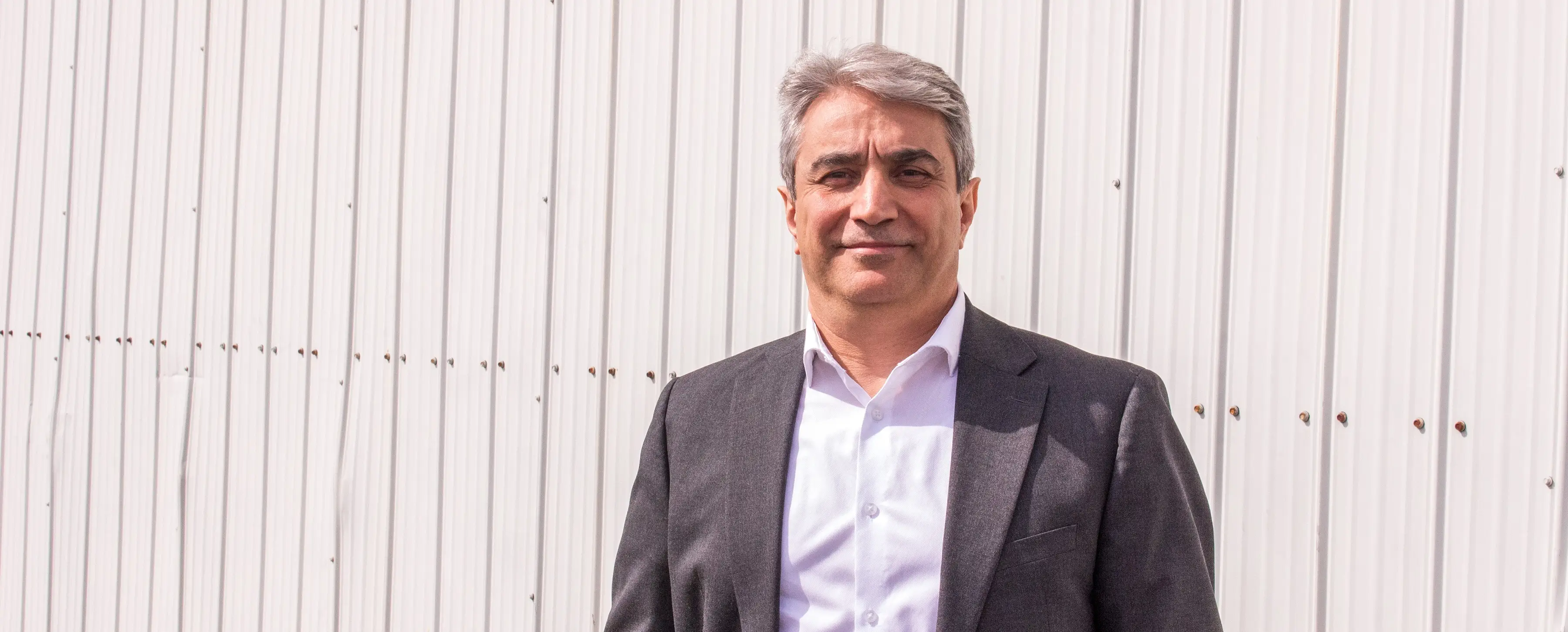
Uncertainty is the enemy of every engineer. Homayoun Najjaran has spent his career turning it into a science.
“Wherever the information you have isn’t accurate—is uncertain—that’s the analytical heart of what we do,” says Najjaran, professor of mechanical engineering at the University of Victoria (UVic). “If you have an autonomous system, you have to deal with a lot of uncertainty. Measurements are imperfect. Models are incomplete. You need mathematical tools for managing that.”
It’s a question that has driven his work since his PhD, long before AI became a household word. And it turns out to be exactly the right question for the moment we’re in.
How AI powered drones can map the unknown
One of the most significant applications of this thinking is an aerial mapping system developed in Najjaran’s Advanced Control and Intelligent Systems (ACIS) lab: a drone that can fly into an environment it has never seen before, survey it, and build a detailed three-dimensional model, entirely on its own.
The challenge, he explains, isn’t just the mapping. It’s that the drone often doesn’t know what it’s looking for.
“It’s like scanning the dark side of the moon,” he says. “You don’t know what’s there. You’re in untested waters. You need an intelligent agent.”
The system uses photogrammetry, a technique that stitches overlapping camera images into three-dimensional reconstructions with texture, scale, and millimetre-level precision, combined with what Najjaran calls “language embedding,” a way of labelling and giving context to each object in the map. This matters for inspection work, where the goal isn’t just to chart a space but to find what’s wrong with it.
“We call it the haystack problem,” he says. “You collect hours of video and sensor data, and somewhere in there is a tiny crack or fault. Humans aren’t always able to find it. The drone, equipped with our software, can.”
A lab built on big questions
Najjaran joined UVic in 2022, drawn in part by the university’s Centre for Aerospace Research (CfAR), which had already built a strong foundation connecting drone research with industry and real-world applications. But his work with autonomous systems goes back much further.
His first drone project was in 2006, with a company in Salmon Arm, BC, that was among the earliest drone operators in Canada. The problem they brought him was simple on the surface: their pilots couldn’t reliably land their drones on a target. His solution was an inflatable landing pad in a specific colour that the drone’s camera could detect and lock onto, automating the final approach. It was an early demonstration of a principle that still drives his work: give an autonomous system the right information and it can handle the rest.
At that time, he estimates that there were only five or six labs in the world working seriously on autonomous drone systems. Canada was an attractive place to do that work as regulations were relatively open compared to the United States, where drone research outside of the military was heavily restricted. That regulatory openness remained the same as other countries caught up, but Najjaran expects Canadian research to accelerate as restrictions ease and vast new areas of the country open up to drone operations.
Today, the ACIS lab has grown to 30 graduate students, all working at the intersection of applied AI and robotics. The thread connecting everything, Najjaran says, is that core question of uncertainty, and how to build systems that can act reliably even when their sensors are imperfect, their maps are incomplete, and the environment keeps changing.
“AI has been around much longer than most people realize,” he says. “What’s changed is the shift to data-driven approaches and systems that learn from the world rather than following hand-coded rules. Robotics has always needed that. We were just waiting for the tools to catch up.”
That computational power is now closer than ever. UVic is home to Arbutus, the largest cloud computer installation for academic research in Canada—a recently expanded $16.4 million infrastructure that gives researchers access to processing power a thousand times faster than a standard computer. For a lab working with the kind of high-resolution mapping data that ACIS generates, that kind of capacity makes their work possible.
Dual-use AI drones: from disaster response to defence
What makes the aerial mapping system especially powerful is that the same core technology works across both civilian and defence applications, what in engineering is called “dual use.”
On the civilian side, the system is designed for infrastructure inspection, environmental monitoring, disaster response, and land-use planning. It’s especially valuable in remote or hard-to-reach places, where sending human experts is slow, expensive, or dangerous. BC alone accounts for one-third of Canada’s natural disaster recovery spending, and as floods and wildfires become more frequent, the need for fast, accurate data is growing.
On the defence side, the same tools take on a different role. The ability to autonomously map unfamiliar terrain at high resolution makes the system well suited for intelligence, surveillance, and reconnaissance missions. The natural language interface, which is the same feature that lets a community planner ask about flood paths, can just as readily help military operators find and analyze features on a tactical map.
Two additional capabilities make the system viable for both contexts. The first is an obstacle detection system that allows the drone to navigate safely in complex or crowded airspace in real time, which is an essential capability whether you’re inspecting a busy urban area or conducting a covert mission. The second is a set of secure communication protocols that protect the data the drone collects from interception or tampering, keeping sensitive information safe.
Drone technology for flood and wildfire risk
A consistent thread running through the ACIS lab’s work is that the technology has to function in the hands of people who actually need it, not just in controlled conditions. An early project with Cowichan Tribes Emergency Services tested the system in a real community setting, helping emergency planners think through how the technology could support disaster preparedness in small and remote communities. Utility companies that manage powerlines and natural gas infrastructure have begun conversations about using the drones to inspect equipment in rugged back country. The marine industry has shown interest in rapid shipyard surveys.
The defence potential is equally broad. Autonomous drones equipped with this kind of AI can monitor vast, remote areas like stretches of coastline, unpopulated border regions, or terrain that would take days to cover on foot. And they can do so quickly and without putting personnel at risk.
“What if we could better assess the risks and enact more effective mitigation measures? This tool can’t prevent a wildfire. But it can help ensure a community is more aware of what’s coming,” says Najjaran.
How UVic’s AI drone research is reaching the real world
Now, with the technology advancing, the next step is getting it out of the lab entirely. Todd Charter, a UVic master’s grad, is the engineering operations manager of the ACIS lab and president of the lab’s spinoff company, Cognia AI. He is leading that push, with the goal of enabling small and medium-sized enterprises to take the platform and build on it commercially.
“What we’re building at Cognia AI is a way to put this technology in the hands of the people who need it most,” he says. “Whether that’s an emergency management team in a remote community, a utility company inspecting infrastructure, or an operator who just needs accurate data fast, the goal is to make something that was once only possible with a team of specialists into something any qualified operator can deploy.”
The regulatory environment is also catching up. Transport Canada is moving toward easing restrictions on beyond-visual-line-of-sight drone operations, a change that will open up new possibilities across Canada’s vast rural landscape.
The applications, Najjaran says, keep expanding. “From floodplains and power lines to the places most people will never see. The sky really is the limit.”