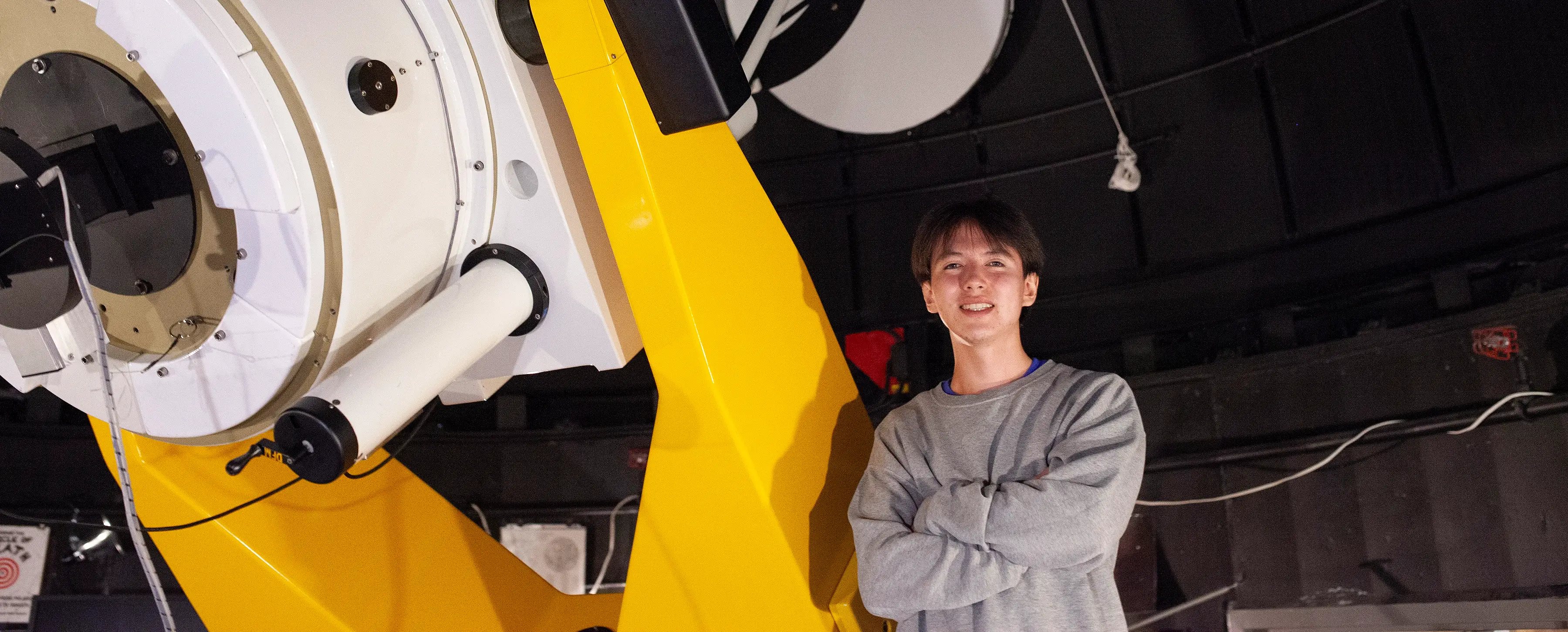
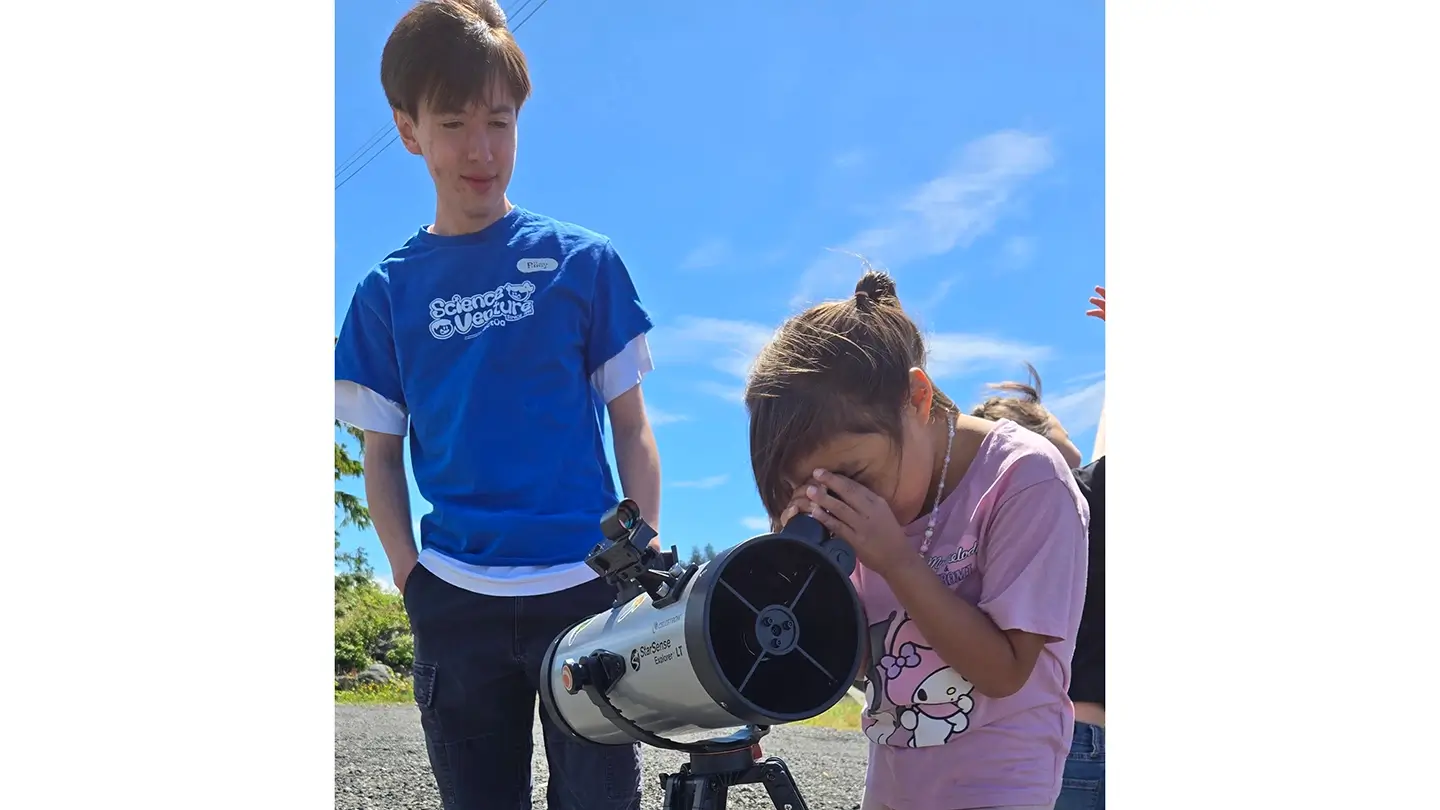
Riley Friesen discovered his passion for the mysteries of space in high school. Today, as a fourth-year student in astronomy and physics and a member of the K-12 Indigenous STEM (InSTEM) outreach team, he shares his love for science and the stars with young Indigenous learners through summer camps.
A recent gift from a University of Victoria (UVic) alum and their partner will strengthen STEM opportunities along the learning pathway, from elementary school to post-secondary education to graduate studies. The gift of $1 million US ($1.3 million Canadian) will establish an endowment for a new entrance award for Indigenous students, increase access to experiential learning placements in climate and sustainability and boost K-12 Indigenous STEM outreach programming.
Elizabeth Croft, UVic’s provost, highlights how the gift expands invaluable applied learning opportunities.
Experiential learning challenges students to step into new environments, build relationships and make sense of complex situations. In those moments, they discover what they’re capable of and build confidence in applying knowledge to new problems.”
—Elizabeth Croft, provost
“This generous gift will expand access to learning and foster belonging in STEM,” Croft adds. “I’m excited about the pathways it will create for students to succeed and the impact it will have on climate action in communities.”
Cultivating interest in STEM early
Raised in Kamloops, Friesen is Nuxalk of Bella Coola in BC through his mother and Ojibway of Sandy Bay Ojibway First Nation in Manitoba through his father. He was inspired to do science outreach after leading an astronomy event for Indigenous students and community at the First Peoples House at UVic in fall 2025.
I enjoy learning science so much that I want to share it with others and encourage them to think about their future. I think initiatives like Indigenous STEM outreach are critical to unlocking possibilities.”
—Riley Friesen, fourth-year student, physics and astronomy
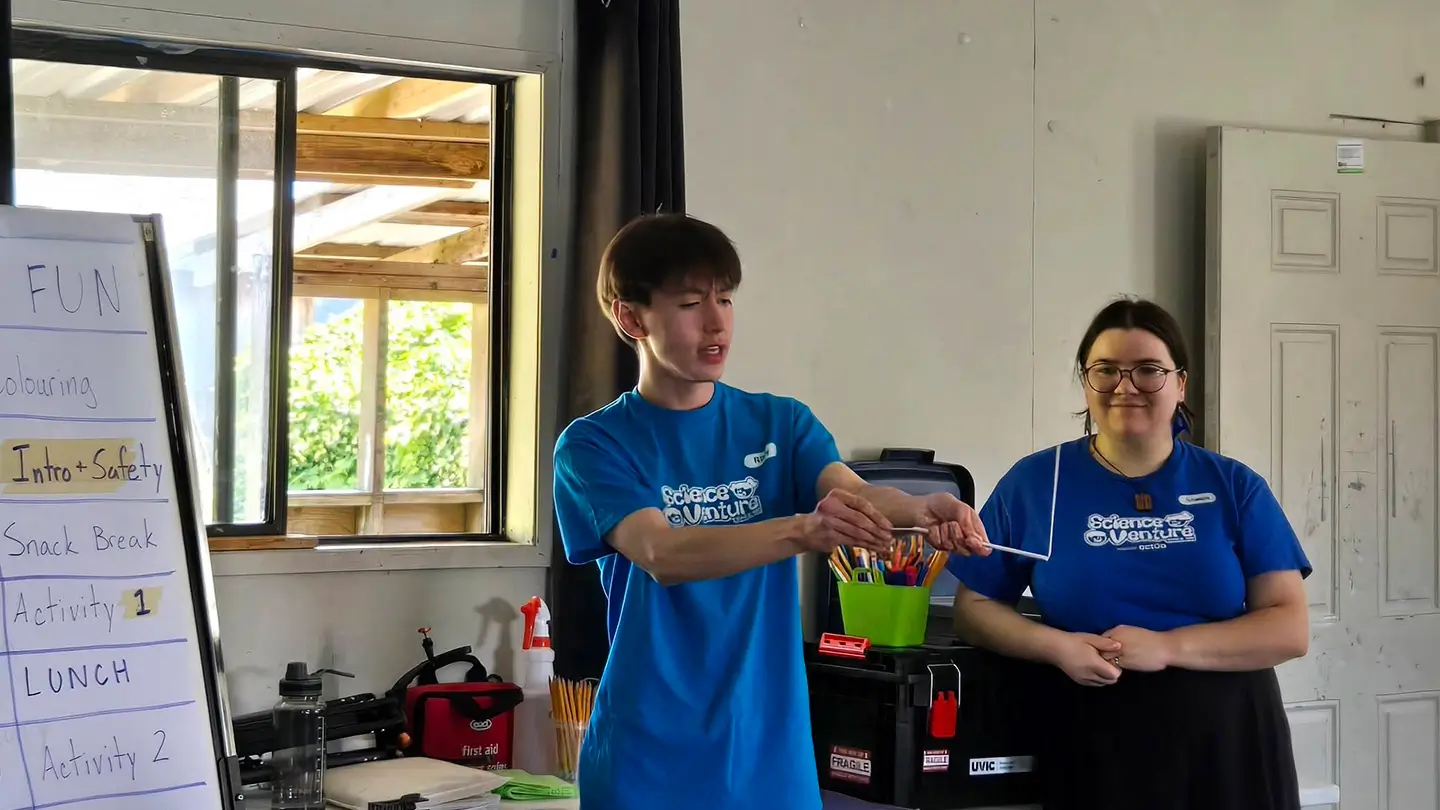
In 2026, Friesen joined Science Venture in a part-time role before joining the InSTEM travel outreach team this summer to deliver summer camp programming. He has worked with Indigenous communities across Nuu-chah-nulth, Kwakwa̱ka̱ʼwakw, W̱SÁNEĆ and Lək̓ʷəŋən territories, as well as with urban Indigenous communities. The summer camps blend traditional Indigenous knowledge with modern science. Using a telescope, he invites young learners to explore the universe through both perspectives.
“Across cultures and throughout history, humans have looked up at the stars, identified patterns and found meaning in what they saw. Indigenous teachings, for example, include using stars to understand seasons,” explains Friesen. “We can show that other perspectives in science are welcome.”
From summer camps to post-secondary
The InSTEM outreach program is a partnership with Indigenous communities and organizations on Vancouver Island, bringing STEM opportunities to Indigenous youth in their home communities. From January to September 2026, the program reached about 990 Indigenous youth (ages 5–11) across 16 communities.
Since many remote communities are difficult to access, the new gift will help to bring STEM programming to more youth, deepen relationships and create a lasting impact for young learners.
Alison Wale, capacity building coordinator, Uu-a-thluk shares, “I have the privilege of watching children grow year after year and seeing their excitement when it’s time for the next camp. Continuity in camps helps to plant seeds of possibilities.”
Wale says STEM camps are invaluable for children to build confidence, skills and knowledge that support future Indigenous leadership. “In my role, I’m helping to build capacity for Nuu-chah-nulth Nations to lead their own fisheries department in the future. Science camps can help lay that foundation.”
She sees Friesen’s role as doing more than educating on the wonder of the stars.
For these children, they see an Indigenous student following his dreams in astronomy. It’s an opportunity for young people to see themselves in post-secondary education. Representation matters.”
—Alison Wale, capacity building coordinator, Uu-a-thluk
Making university and hands-on learning more accessible
This donation will make those dreams of post-secondary education more realizable through a new entrance scholarship. From September 2027 onwards, one or more students will receive $9,000 towards their first year of studies, covering a significant share of the costs associated with attending university.
In addition, multiple students at the undergraduate and graduate levels will gain experiential learning opportunities through expanded funding for co-op education placements in climate leadership, the Sustainability Scholars program and the Coastal Climate Solutions Leaders program (CCSL).
These UVic programs offer experiences that bridge the gap between classroom concepts and real-world practice. Thanks to this gift, students will have more opportunities to work alongside—and be mentored by—professionals, researchers and community partners, contributing directly to climate solutions while building skills for the future. The donor’s own co-op experiences were instrumental to their career advancement. Through this gift, they and their partner are extending that opportunity to more students.
Bryan Woodward, a Master of Environmental Studies graduate, says, “CCSL was a major highlight of my master’s degree, as it taught me the importance of working across disciplines to develop meaningful climate solutions. It also strengthened my practical skills, boosted my confidence and expanded my professional network—preparing me well for future opportunities.”
Inspiring the next generation of Indigenous climate innovators
The new funding will help to boost Indigenous leadership in science and climate action by supporting learners as they explore, engage and excel in STEM through their entire educational pathway. The gift augments UVic’s commitments to Indigenous student success through programs such as the Indigenous Living Learning Community, Elders in Residence, LE,NOṈET program and courses, LE,NOṈET Campus Cousins program and other events and cultural activities at the First Peoples House.
Friesen lights up when he talks about one of his role models in astronomy, Cree Elder Wilfred Buck, who he met at a UVic event. “Wilfred Buck is so cool. I had the opportunity to hear his teachings on astronomy and culture. It was incredible,” he says.
Yet for many young people in the summer camps, Friesen is already a role model himself—someone who looks up at the sky, tells star stories and helps others imagine their own future in STEM.
Read the UVic Expert Q&A on Indigenous STEM outreach programs.