The University of Victoria’s Faculty of Law is now home to a new Indigenous Law wing. It supports the growing movement of Indigenous Laws empowering communities to reclaim and exercise authority over their own legal systems.
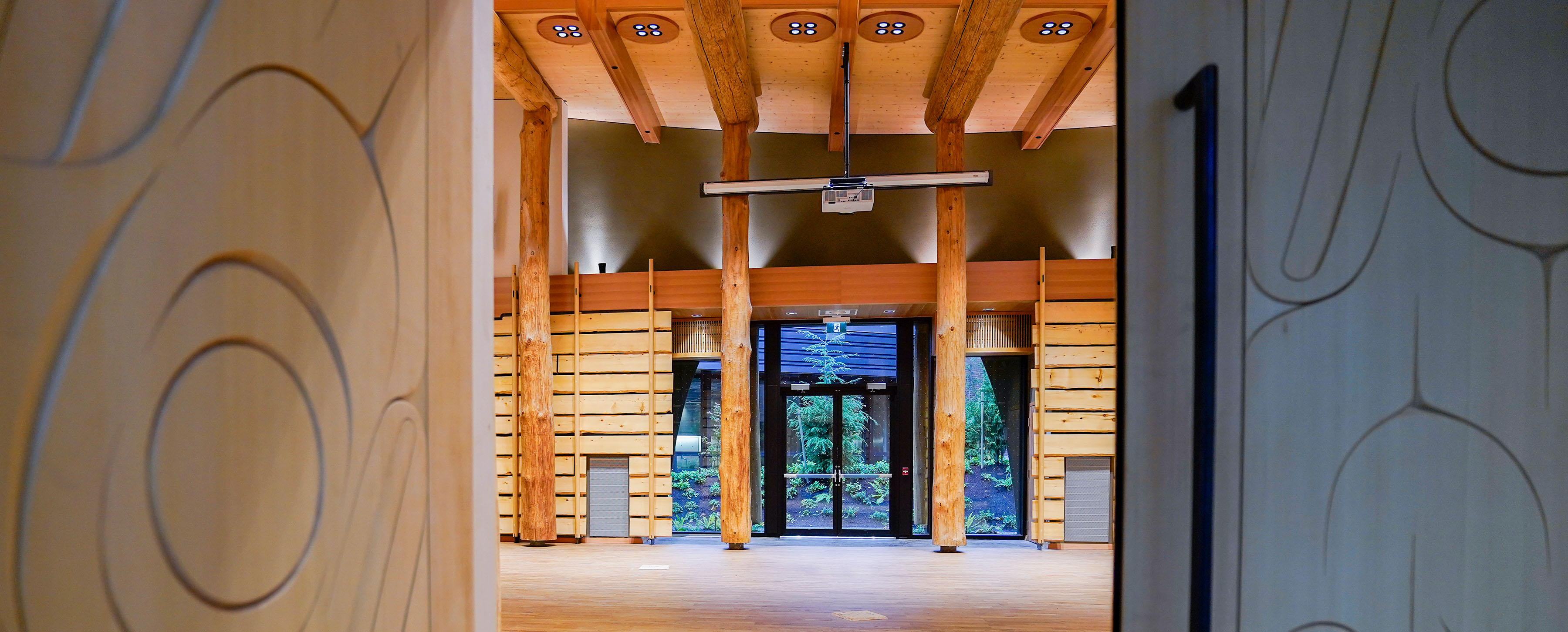
The Coast Salish-inspired building helps fill a long-standing gap by providing much-needed classrooms and spaces for teaching and learning Indigenous Law.
“We’re thrilled to see the building come to life,” says Freya Kodar, Dean of Law. “The space will support our students and community by integrating Indigenous knowledge and legal traditions, helping enrich our programming and create a more inclusive learning experience, serving as a centre for conversation, research, education and training about Indigenous Law.”
The new Indigenous Law wing responds directly to the 2015 Truth and Reconciliation Committee Call to Action 50: to establish Indigenous law institutes. A decade later, you can walk the journey of this response, starting with a continuous circulation loop connecting the existing Murray and Anne Fraser Building and the new wing.

Every angle of the 2,440-square-metre building thoughtfully tells stories of Coast Salish legal traditions from Lək̓ʷəŋən and W̱SÁNEĆ Peoples, whose relationships with the land and university helped shape the building into existence.
The project was shaped by years of consultation with hereditary and elected leadership, community members and Elders from Xʷsepsəm/Esquimalt and Songhees particularly, as well as W̱SÁNEĆ, and Elders who work with UVic’s Office of Indigenous and Academic Community Engagement.
The design team heard 13 stories from local First Nations during consultation. These were then translated into design elements and narratives that shape all aspects of the space. These design features were recognized in a 2023 Canadian Architect Award of Excellence.
But the overarching principles heard in consultation—of environment, tradition, stories, witnessing, community and reciprocity—are also ideas behind one of the most powerful movements in the legal field today: Indigenous Law.
What is Indigenous Law?
Across Canada, Indigenous societies are reclaiming jurisdiction and governance by revitalizing and implementing their own legal traditions rooted in oral histories, stories and teachings. These laws, which vary in each Indigenous society, cover everything from violence to childcare practices and have long existed prior to colonial frameworks.
Indigenous Law will make Canada a better place by strengthening civil society, democracy, and expanding the legal imagination and rule of law.”
—Val Napoleon, Law Foundation chair in Indigenous Justice and Governance
Napoleon is a trailblazer in this field. She’s created processes to gather and interpret oral histories and stories that inform Indigenous Laws, which support Indigenous peoples to rebuild, restate and apply them in contemporary contexts.
This work is part of a movement toward Indigenous self-determination— Indigenous communities restoring authority over their own legal matters.
“The work done today is only possible because of generations of Indigenous peoples who have maintained their lawfulness wherever possible, and from the vital scholarship of colleagues like John Borrows and so many others,” says Napoleon.
Now, Napoleon says the new Indigenous Law wing can further inspire the next generation to continue the work.
This physical structure is a space where our laws, which enable us to be peoples, may be explored, taught and argued by Indigenous and non-Indigenous learners. Students are receiving a legal education like no other – they are critically engaging with, practicing and theorizing about our laws, and in doing so, they are continuing to build the foundation for a multijuridical Canada.”
—Val Napoleon, Law Foundation chair in Indigenous Justice and Governance
One example of revitalizing Indigenous Law is the Cowichan Tribes’ recent progress in child and family services. UVic Law’s inaugural Associate Dean Indigenous Law Sarah Morales and her father, UVic Law alum, Robert Morales, collaborated with Cowichan to develop laws and agreements that recognize the Tribes’ inherent right to self-government.
The result was formal agreements with federal and provincial governments in 2024 that support the recognition and implementation of Cowichan Tribes’ Child Welfare Law —an important step in restoring jurisdiction over child and family welfare.
This is just one example that adds to the growing sentiment behind rebuilding Indigenous Laws as a substantive and impactful field, which is now accelerated through a physical, culturally appropriate space says Morales.
“Indigenous Law is being recognized across the country—in our Indigenous communities, federal and provincial laws and policies, and even within Canadian courts,” says Morales.
The challenging work of determining the relationship between these laws and legal orders still confronts us. This new space offers a home for that work. A place where we can gather to take up complex conversations about new pathways for implementation in a good way, fostering real change for Indigenous and non-Indigenous peoples alike.”
—Sarah Morales, Associate Dean Indigenous Law
The building: wood, water and bringing the outside in
Coast Salish teachings rooted in Indigenous Law are imbedded everywhere in the building design, says Mohawk Architect Matt Hickey with Two Row Architect, an Indigenous architecture firm that worked on the consultation and design, in partnership with Teeple Architects and Low Hammond Rowe Architects.
Hickey can list these teachings off the top of his head: “The flora and fauna, the relationship to water, the importance of languages and how we speak to the world around us. There’s also witnessing, which is of Coast Salish culture and very much connected to law and the judicial system.”
The design team carefully strategized to retain, replace and reuse existing and felled trees on the site. The building location was chosen to preserve mature trees, while removed trees were replaced. And the interior of the wing is lined with columns of wood from trees felled from the site.
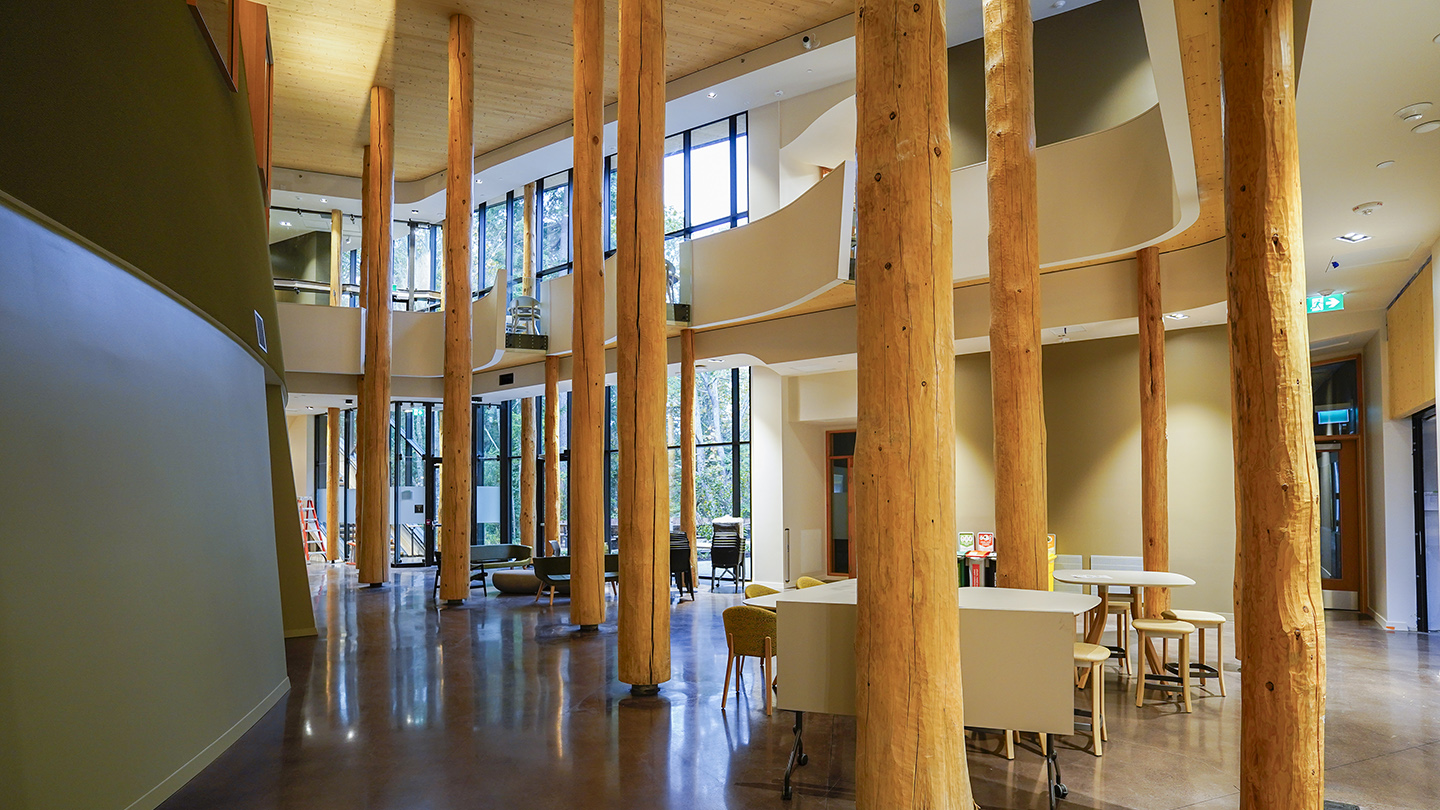
Another teaching is the importance of honouring the cedar tree and all that it provides. On the second floor, the cut-aways on the balcony overlooking the atrium are a reference to the importance of the Coast Salish practice of peeling cedar bark.
Even the unique slope of the building’s roof is a teachable moment, says Hickey. The ever-present Pacific Northwest rain runs off the roof, collects, and nourishes the surrounding environment before flowing into nearby Bowker Creek.
Other Coast Salish-inspired spaces in the wing include: an outdoor learning classroom, honouring the way Indigenous peoples have learned for thousands of years prior to institutional education; a Sky Classroom; an Elders’ Garden; and a circular Small Gathering Space that prioritizes acoustics rather than technology to promote oral storytelling, dialogue and deliberation.
The new Indigenous Law wing houses the joint JD/JID degree program in Canadian Common Law (JD) and Indigenous Legal Orders program (JD/JID), and will be home to the fifth graduating class of the program in 2026.
The new space also houses the Environmental Law Centre, the Indigenous Law Research Unit and the Access to Justice Centre for Excellence.
The building, funded by $18 million from the provincial government, $9.1 million from the federal government and $11 million from the Law Foundation of BC, is meant to inspire students, staff and faculty by connecting them with the land and Indigenous knowledge—creating space for the next generation of Indigenous thought leaders to grow.