

When University of Victoria (UVic) graduate (PhD, 2024) and instructor Janice Niemann sat down to watch a new Crave original series in December 2025, she didn’t expect that less than a year later, she’d be teaching a course on it.
Like many viewers of the award-winning queer hockey romance Heated Rivalry, Niemann was immediately hooked. She bought all six novels in the Game Changer series and read them over a single weekend before classes began in January. Inspired by the books and their television adaptation, Niemann reworked her upcoming erotic literature course to include Rachel Reid’s novels.
Pop culture’s impact
Niemann’s students devoured the material. In fact, student response was so overwhelmingly positive that the faculty asked Niemann to develop a full course on Heated Rivalry.
While still teaching the classics such as Petrarch and Shakespeare, we think it’s important for our faculty to bring literary studies into conversation with current popular media and culture. Heated Rivalry has had tremendous cultural impact through its rounded depiction of queer characters, its situating a queer romance on the hockey rink and its unabashedly Canadian content. Janice Niemann, who I supervised as a doctoral student, specializes in queer literary texts and is supremely equipped to lead this course.”
—Lisa Surridge, Associate Dean Academic
This fall term—as Heated Rivalry’s second season films in Toronto and Reid’s fall tour takes her from New York to Vancouver—Niemann is teaching ENSH 321: Authors on Screen – Rachel Reid’s Heated Rivalry.
The course is a special iteration of a class that has been taught at UVic since 2023. It examines what happens when a book is adapted for television.
Seats filled up so quickly that more had to be added. Now, over 100 students gather each week to analyze Reid’s novels alongside the six-episode Crave series through the lens of adaptation studies, queer theory, fanfiction and fandom.
Celebrating queer joy
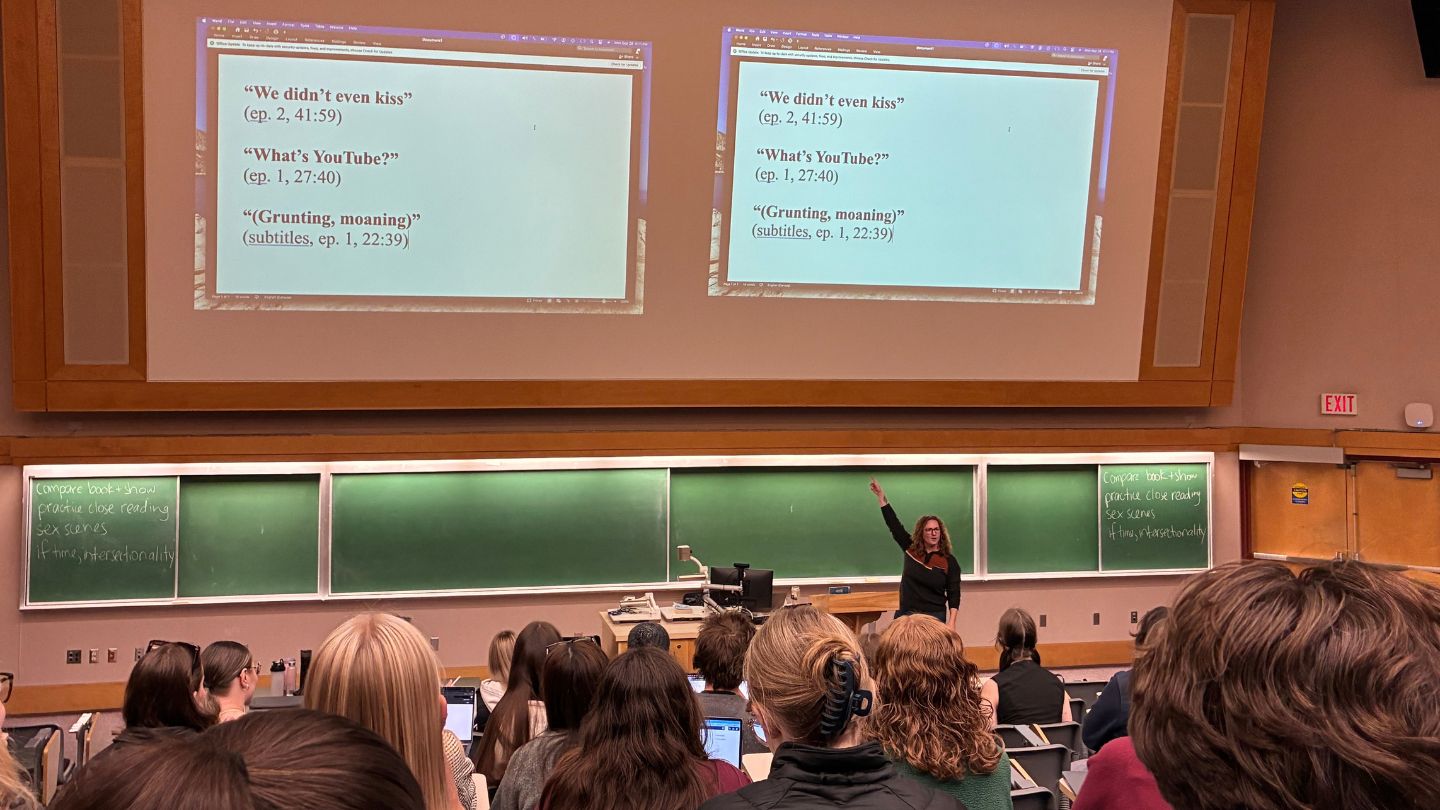
Teaching Heated Rivalry in university classrooms challenges the longstanding idea that media targeted to women and queer people is trivial.
“I want my students to get joy out of this class,” says Niemann. “I want students to know that their interests are worth teaching in the classroom and taking seriously.” She points to classics like Pride and Prejudice as evidence that romance novels have always merited serious study.
Across campus, the Heated Rivalry phenomenon has also made its way into law school classrooms. LAW 357: Queering Law, taught by Gillian Calder, explores popular culture as a medium for understanding law. This semester, students will use central themes from the show, including consent, gender, sexuality and masculinity, to explore legal concepts.
While they’re approaching the material from different perspectives, Calder and Niemann both identify queer joy as one reason the show became so popular.
As Niemann says, “Having this sort of story is joyful for me, and I think for a lot of people.”