New gallery highlights the stories and science behind BC’s ongoing climate disasters
While world leaders continue to negotiate about the impact of climate change at international events like the annual United Nations COP conferences, the University of Victoria (UVic)-led Climate Disaster Project (CDP) is helping to tell these stories through a new partnership with the Royal BC Museum (RBCM).
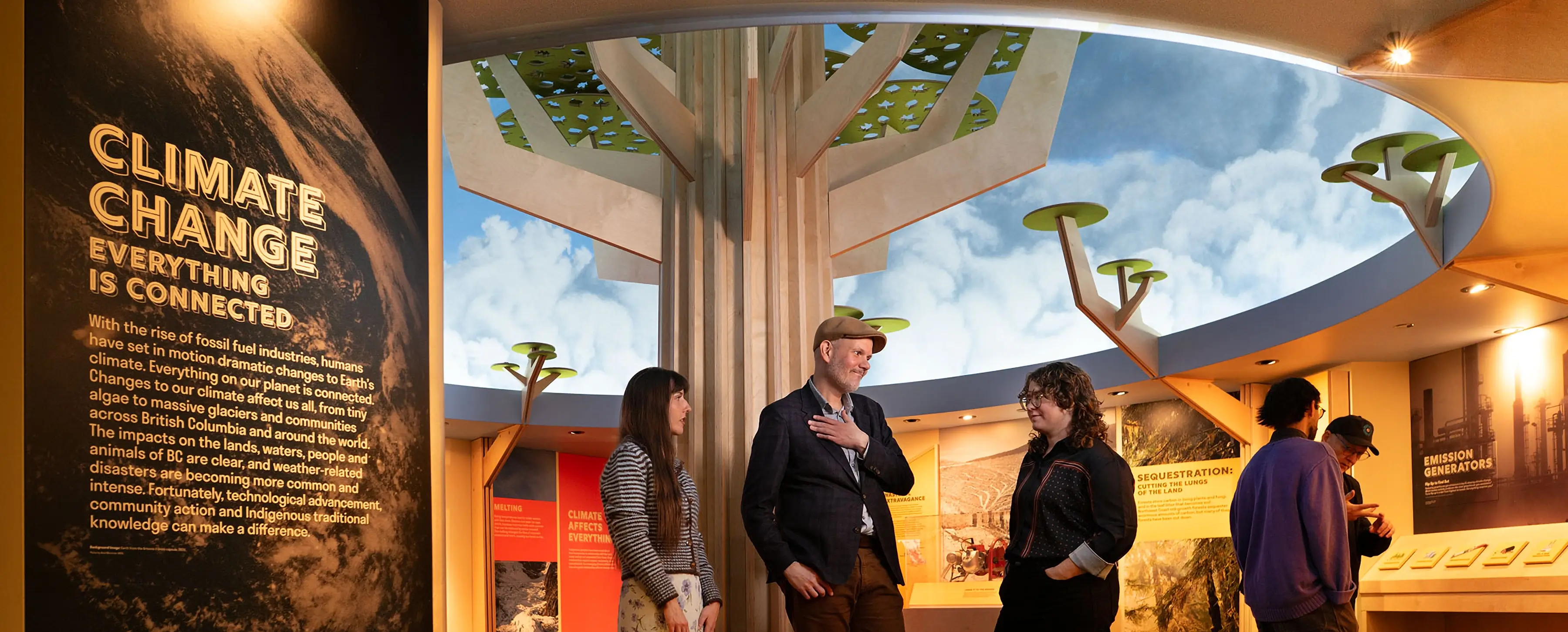
Installed in September 2026, the RBCM’s reimagined permanent gallery Climate Change: Everything is Connected offers a dedicated theatre showing an award-winning micro-documentary series created by CDP students. Also available are projects created by UVic Fine Arts faculty members and students, including a three-dimensional scientific display and a presentation on the Indigenous-led Totem 2.0 project.
We know that museums are among the most trusted institutions in our society, institutions that play a crucial role in telling and sharing our stories.”
— Alex D’Arcy, UVic associate vice president, research
While the impact of extreme weather events is felt locally, survivors’ voices are seldom heard at the national or international level. The CDP is helping to change that.
“This is what partnership looks like: this is the power of bringing the academy together with public education and the memorialization and celebration of life … even when, especially when, the impact of our world threatens all that we hold dear,” continues D’Arcy.
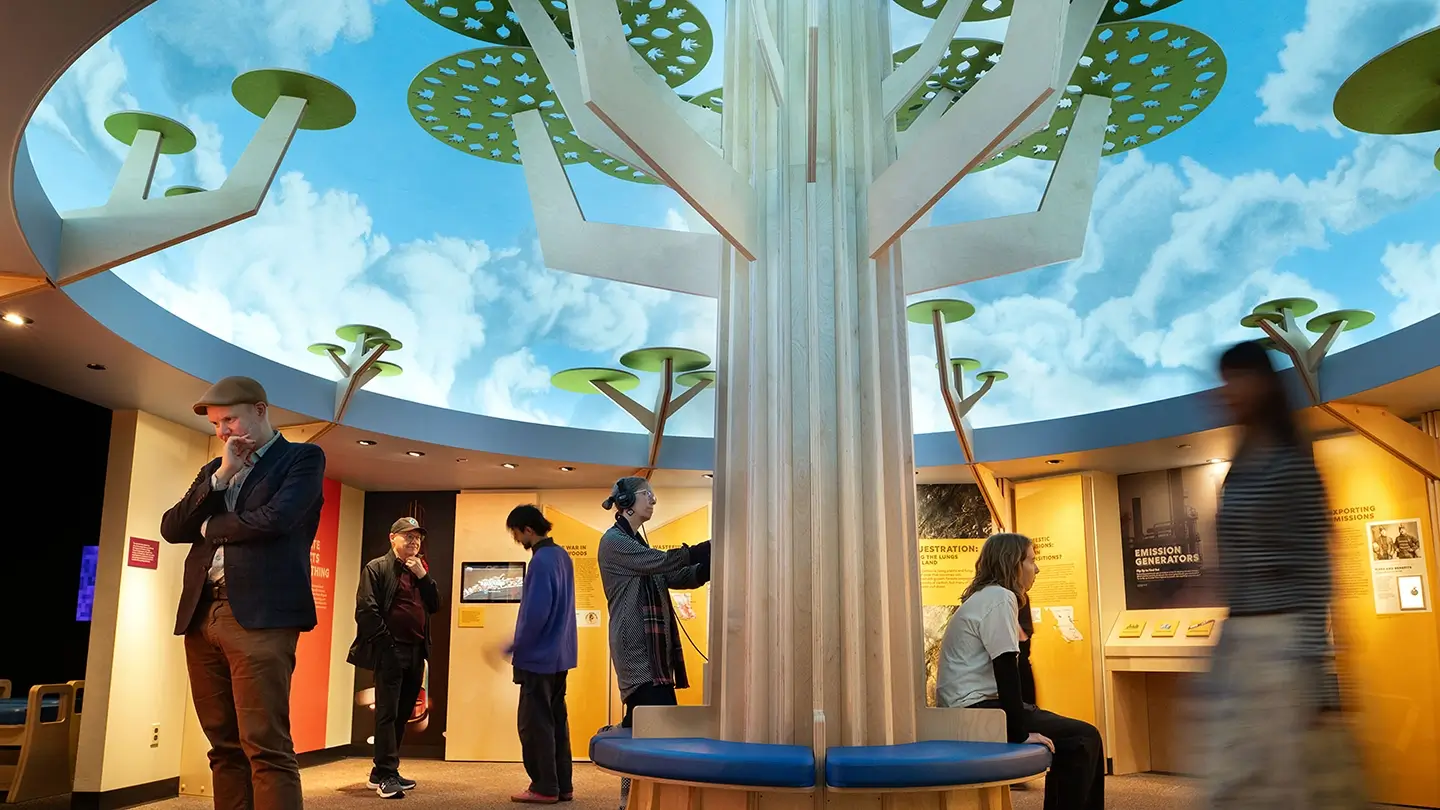
Telling BC’s climate story
Faculty of Fine Arts participation in the RBCM project is led by Sean Holman, CDP founder and the Department of Writing’s Wayne Crookes Professor of Environmental & Climate Journalism.
Holman worked with his CDP students and Digital Interactive Media & the Arts (DIMA) professor David Leach plus Visual Arts/Art History & Visual Studies professor and UVic Impact Chair Carey Newman to develop and place content in the renewed gallery. Together, they created a new series of displays for RBCM visitors that offered UVic students a valuable opportunity to see their creative projects included as part of an important display in a prestigious institution in Victoria, BC.
The evidence for human-caused climate change is clear. In this new exhibit, we’re not just telling the story of what might happen, but what is and has been happening, and how the people of BC will need to adapt.”
—Victoria Arbour, Royal BC Museum manager of research & collections, and curator of palaeontology
Using creativity and technology to engage the community
Included in the RBCM gallery is the micro-doc series Disaster at Our Doorsteps, featuring survivors of 2021’s western North America heat wave, Pacific Northwest floods and Lytton Creek fire—as documented by students Maia Senga, Athina Merckx, Ella Stemler and Lilia Lavoie.
“Our students worked with these five climate disaster survivors across BC to share their experiences and wisdom,” notes Holman. “Too often the stories we’ve told about climate change have been stories about the future and about our environment—and those stories are important, they’re vital … but it’s also meant the people who have been impacted by climate change in the present, in our neighbourhoods, in our communities, in our lives, have not been part of the climate conversation.”
RBCM visitors can also engage with the immersive 3D spatial reality display “Tiny Glass Heroes” created by Leach’s DIMA student team. Using custom equipment provided by SONY Canada and supported by UVic’s Office of Research & Innovation, students Nick Patterson, Nathan Inbar, Edith Skeard and Annie McLure explore the environmental impact of diatoms. Diatoms are microscopic algae found in the world’s oceans, waterways and soils which produce upwards of a quarter of Earth’s oxygen and offer a good example of how climate change also impacts invisible systems.
Another highlight is Newman’s Totem 2.0 project, a ground-breaking spinning-harness technology that bridges traditional Indigenous art practices with modern engineering solutions to enable totem-pole carving using sustainable second-growth cedar beams. A looped video shows this innovative apparatus in action, while a monumental photo showcases the resulting internally-lit totem—appropriately titled “Ḵ̓a̱mtila – To write a new song”—that is now permanently installed outside Pacific Opera Victoria’s downtown Baumann Centre.
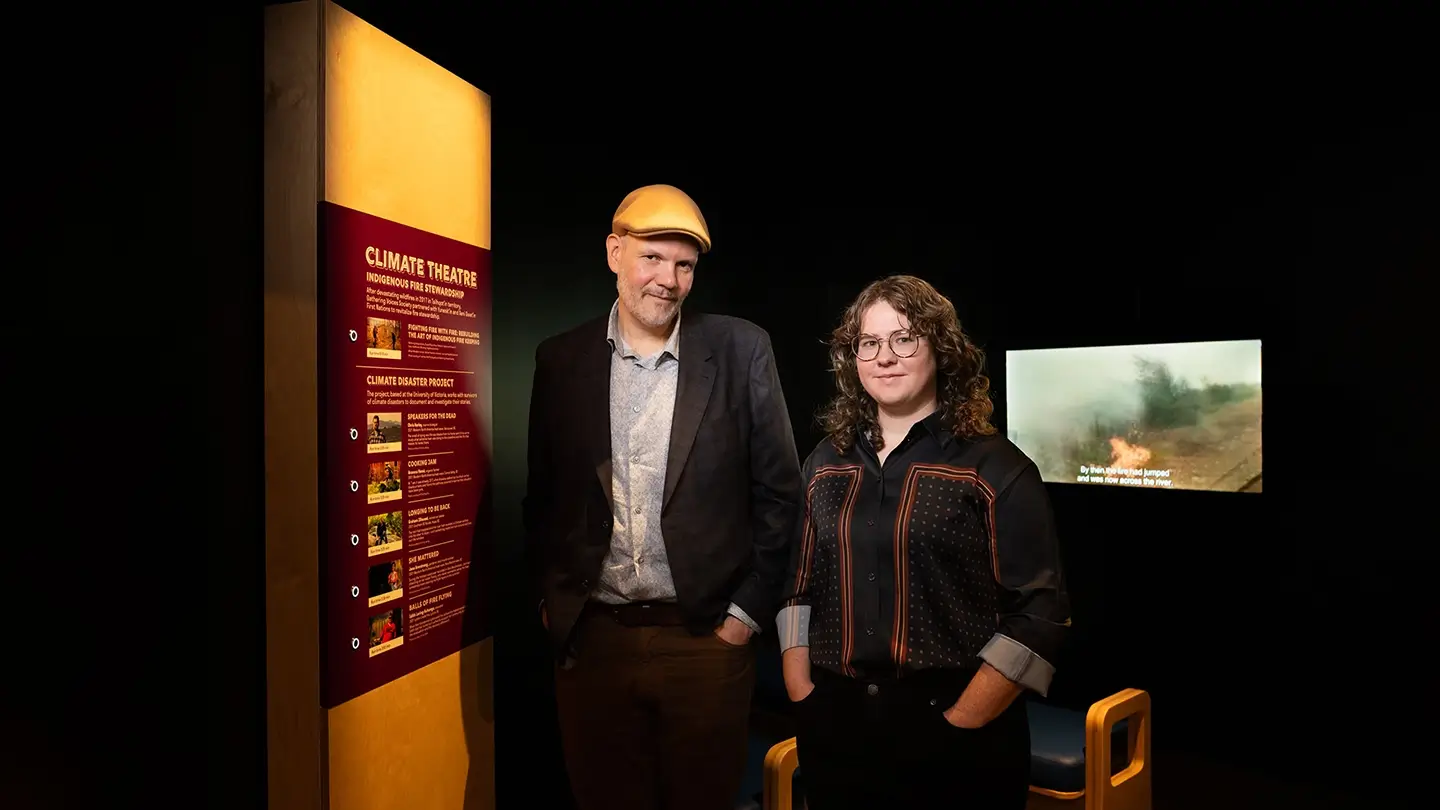
Local partners in action
One of the oldest continually operating museums in Canada, the RBCM is a vibrant centre of learning, research and community engagement which welcomes 600,000 visitors a year. By combining the RBCM’s resources and legacy with the research and creative activity of the Climate Disaster Project and the Faculty of Fine Arts, the renewed gallery now tells the continuing story of climate change in new and dynamic ways.
“The work that Sean Holman, David Leach and Carey Newman and their teams have done demonstrate the power that happens when students and scholars in Fine Arts partner with people who have lived and learned experience with the impact of climate change to share their stories,” says Alex D’Arcy, associate vice-president, research.
The climate conversation in this province has included nearly everyone except the people it happened to. That needs to change.”
—Sean Holman, Climate Disaster Project founder
New stories coming out
November 2026 saw the CDP’s third annual partnership with the UK’s venerable Guardian media outlet during the UN-led COP31 talks, where four climate-survivor testimonies were shared worldwide — offering hard-won knowledge and first-person wisdom which can help us all live together in a changing climate.
Spring 2027 will see the release of No Safe Season, an anthology of 36 climate testimonies published by UBC Press, and plans are currently underway for a significant travelling exhibition to debut at Winnipeg’s Canadian Museum for Human Rights in 2029.
Climate change isn’t a threat tomorrow. It’s a trauma today.”
— Sean Holman, Climate Disaster Project founder
The first teaching newsroom specifically dedicated to this kind of educational training and reporting techniques, the CDP has trained nearly 400 students in trauma-informed climate journalism and seen 114 first-person testimonies published, broadcast or presented since its creation in 2021.
Over the past five years, the CDP has been joined by 51 partners from the educational, media and cultural sectors, won or been nominated for 12 major awards, and been awarded a six-year, $2.5-million Social Sciences and Humanities Research Council Partnership Grant to train 500 more students and share the experiences of 1,000 climate survivors internationally.
The University of Victoria is here for what matters—including documenting climate change. Explore how UVic is connecting with the South Island community.