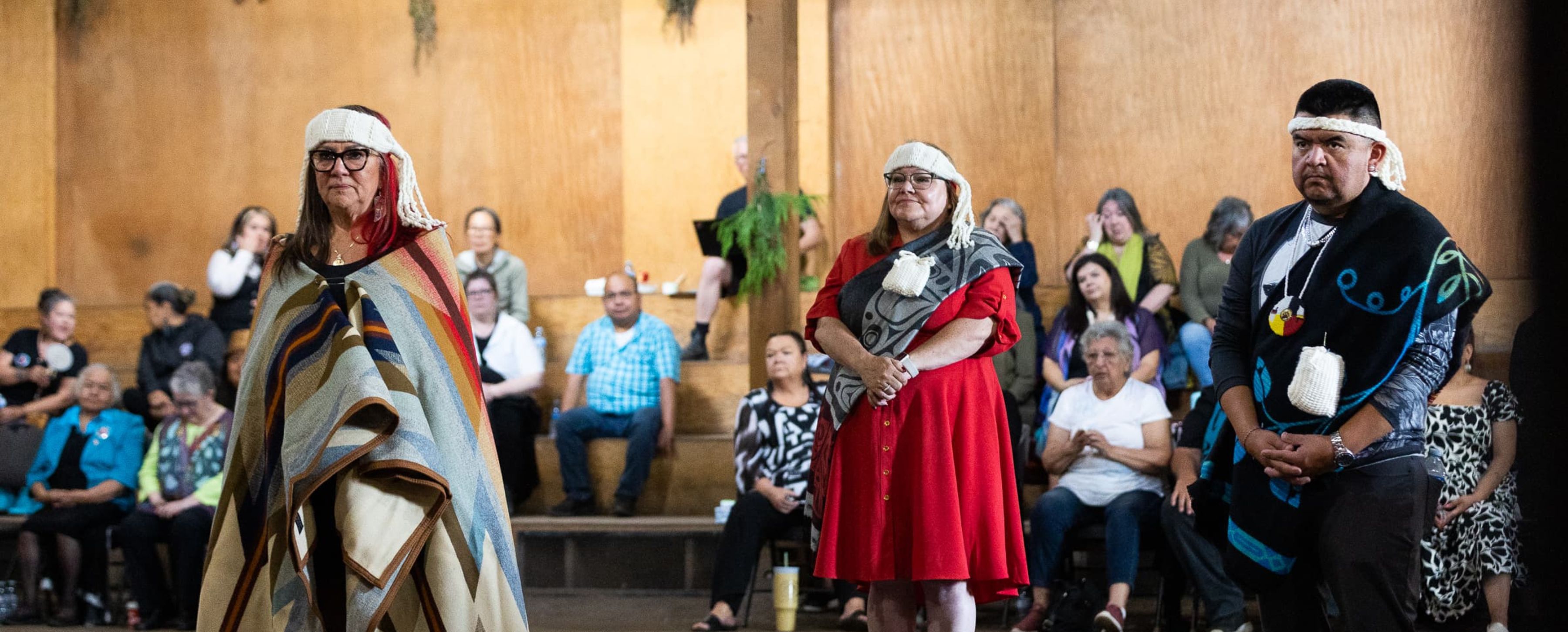

How do we carry the law within us? Anishinaabe Elders speak about the embodiment of law and governance—how law lives within us and should be shaping how we interact with others.
For Heidi Kiiwetinepinesiik Stark—Canada Research Chair in The Embodied Politics of Indigenous Law—the question of how we make law a part of peoples’ every day, embodied practices guide her work in Indigenous Governance at the University of Victoria (UVic). With a focus on building up infrastructures of care that can mobilize relational accountability, Stark’s research seeks to revitalize the Indigenous governing institutions and practices that house and animate Indigenous law.
Stark’s research program highlights embodied practices—such as storytelling, beadwork, quilting and land-based teachings—as pathways through which individuals can internalize and express Indigenous legal principles, cultivating their own capacity to live the law through everyday relationships, responsibilities and actions.
“One of the ways that we carry laws within us is through material practices, such as beadwork, sewing and other forms of artistic expression,” says Stark. “Half of my research is how to enrich our understanding of Indigenous law through these material practices.”
Stark’s forward-thinking approaches to Indigenous law and governance have helped strengthen the renewal of Indigenous political authority and jurisdiction. Grounded in Anishinaabe political thought, her work reshapes how we understand treaty and advances a bold ethic of relationality for how we live together as treaty partners, as communities where conflict and harm can occur, and as people in relationship with the natural world.
“A big part of what I am trying to understand is what happens when we move away from the binary of perpetrator and victim? What if we focus more on the forms of remedy and repair that can occur within community frameworks, that can enable harm and conflict to be addressed,” says Stark.
Her research background includes collaborative work with Indigenous communities in the United States and Canada with the aim to advance the development and resurgence of Anishinaabe political structures and institutions that are informed and shaped by Anishinaabe philosophies, values and teachings.
The Canada Research Chair funding provides space and resources to enable Stark and her research partners in communities to step outside of traditional legal systems and think about what they want, what future they can imagine and how they want to be with one another.
Indigenous law and governance are uniquely suited to take up the most vexing issues facing our world. They guide us away from rights-based models that are too often individualist, extractive and capitalist driven and toward deeply relational modes that centre our responsibilities to one another and the lands and waters.”
—Heidi Kiiwetinepinesiik Stark, associate professor, Indigenous Governance