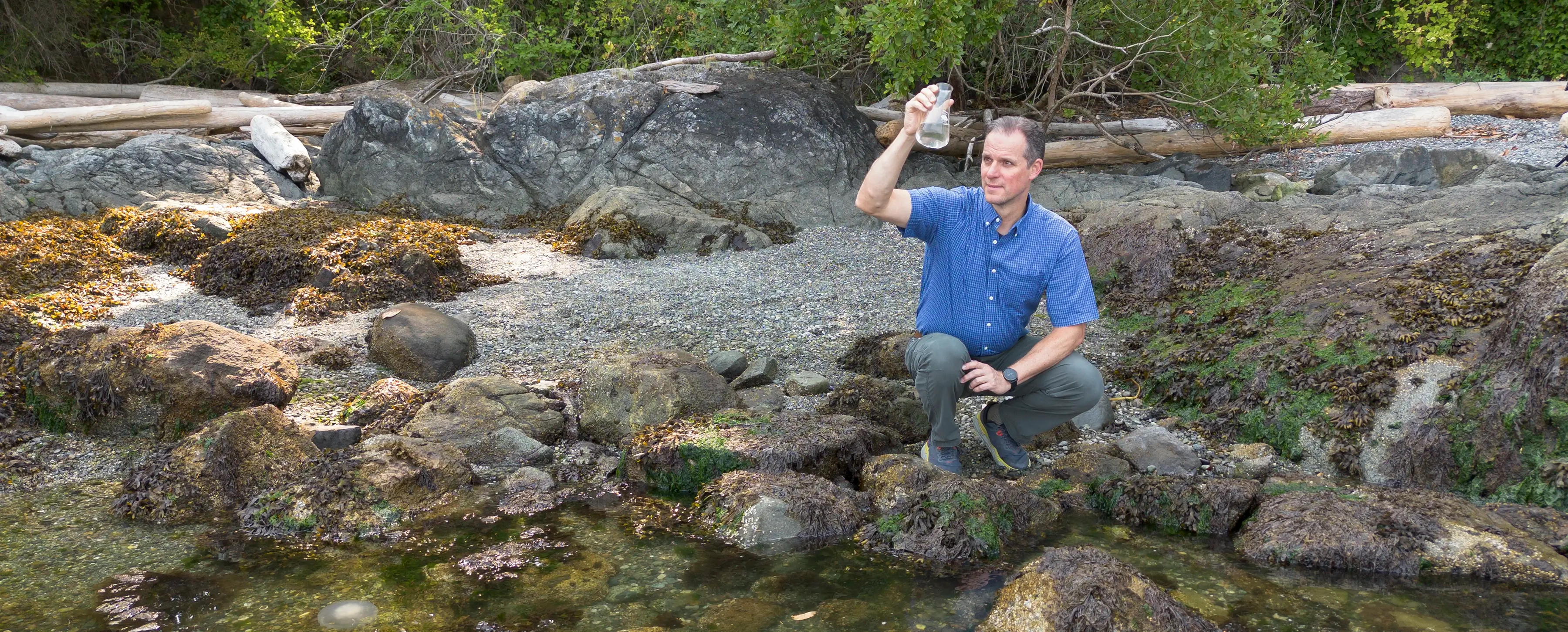
After his first research cruise along Line P in the North Pacific, Adrian Marchetti had his doubts about becoming an oceanographer. The rough seas and bouts of seasickness—it was all a bit too much. But two weeks later, he forgot about all the awful parts and wanted nothing more than to be back on a ship. Now, after 25 years as a biological oceanographer, Marchetti estimates he has spent an entire year of his life at sea on cruises all around the globe—and he still says that first research cruise was the toughest.
Marchetti has recently come to the University of Victoria (UVic) as the BC Leadership Chair in Marine Ecosystems and Global Change. His research focuses on phytoplankton ecophysiology and genomics, looking to better understand the important roles that phytoplankton play in global biogeochemical cycles.
“Marchetti is an outstanding oceanographer whose research is increasing our understanding of phytoplankton’s responses to environmental change,” says Lisa Kalynchuk, UVic’s vice-president research and innovation. “His work aligns closely with the strengths and interests of researchers, communities and partners across UVic and beyond. I’m excited to see his research program grow and contribute new knowledge that will support the future health and resilience of marine ecosystems.”
Using genetic tools to monitor phytoplankton
Marchetti studies how phytoplankton grow, compete and survive under different environmental conditions. His work seeks to explain why certain species dominate in particular regions and how changes in the ocean alter their abundance and distribution.
It’s an indisputable fact that our oceans are changing, from nutrient cycles to the distribution of organisms to the organisms themselves. Phytoplankton are at the very base of our food chain and are responsible for half of the oxygen we breathe. They are often the first to show changes, acting as the canary in the coal mine and raising the alarm. This makes understanding how phytoplankton are changing critically important.”
—Adrian Marchetti, BC Leadership Chair in Marine Ecosystems and Global Change
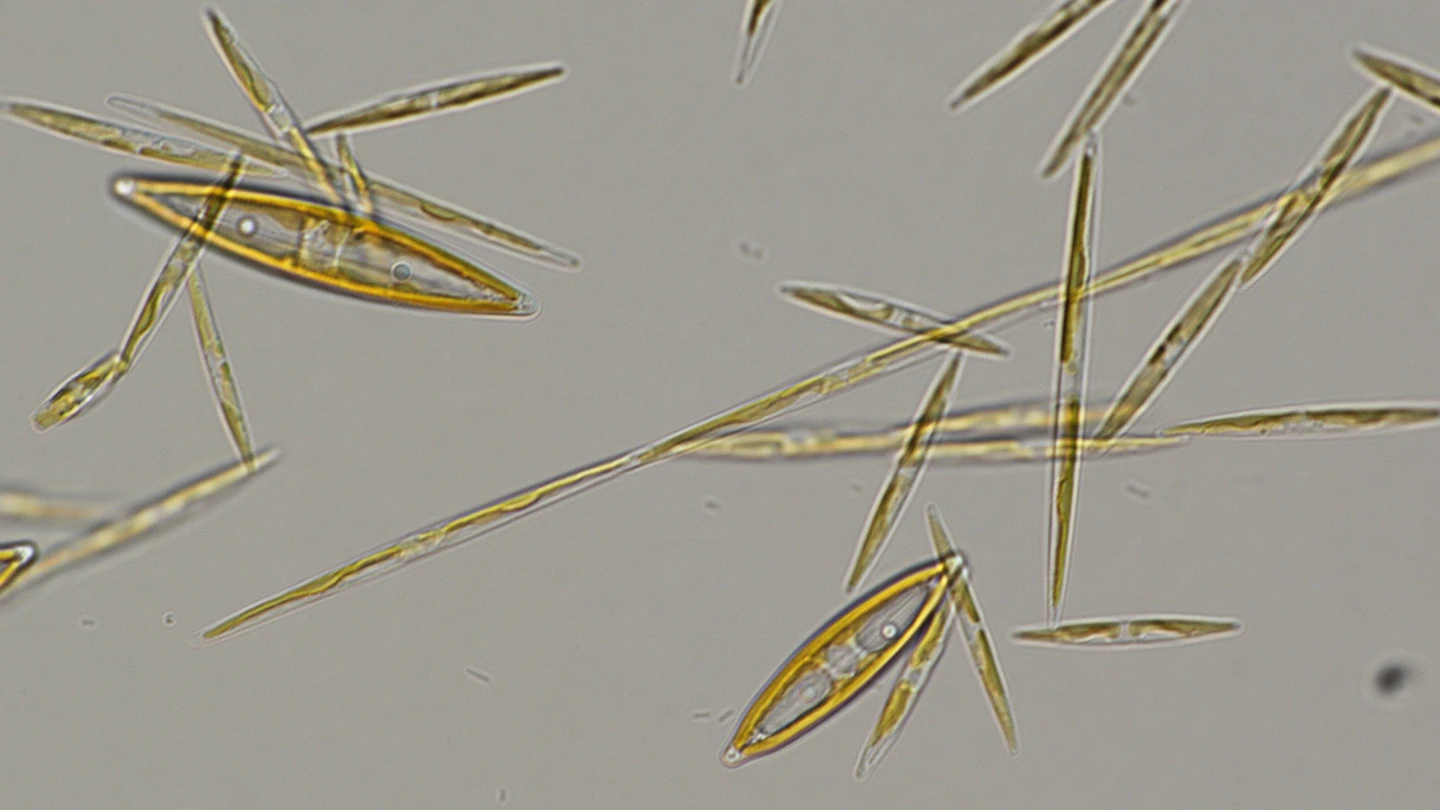
Marchetti’s work combines traditional oceanographic methods with molecular biology. He uses advanced methods in molecular sequencing, such as genomics, transcriptomics and metatranscriptomics, collectively termed the ‘omics, to better understand the taxonomic, functional and genetic diversity of phytoplankton. He also combines field work, where he looks at natural phytoplankton communities to see how they are responding, and lab work, where isolates collected in the field are grown in the lab under specific conditions and their DNA and RNA are sequenced.
From biology student to leading oceanographer
Marchetti didn’t always have his sights set on being an oceanographer. Growing up in Richmond Hill, Ontario, he was nowhere near the ocean, and when he left for McGill University to complete an undergraduate degree in biology, he was on a path to medical school. But after taking classes in biology and oceanography, his interest in the area grew. Wanting to get involved in a research project, he asked a professor about research spots for undergraduate students. This led to work studying the trace metal requirements in diatoms and completing his honours thesis on the topic. It was the beginning of an entire career.
“The opportunity I had to be involved in research as an undergraduate student is the single most important thing in where I ended up,” says Marchetti. “It’s important to me to welcome undergraduate students into my lab so that they can have the same opportunity that I had. UVic’s emphasis on undergraduate research opportunities was a factor in my decision to come here.”
Global discoveries help explain ocean change
Marchetti conducts research across the globe, with research areas focused off the West Coast from BC to California, in the Galapagos Islands and in Antarctica. He has made important discoveries in each of the locations he studies.
Off the West Coast, Marchetti is well known for his research on the effects of iron limitation on phytoplankton. Iron is often the limiting nutrient for phytoplankton growth in large regions of the ocean, but he has shown that some diatoms have evolved ways to survive in iron-poor environments. They use ferritin, an iron-storage protein, to accumulate iron during brief periods of abundance, storing it for later, when the supply has declined.
In Antarctica, Marchetti has discovered that a protein called proton-pumping rhodospin (PPR) is pervasive in Antarctic phytoplankton. Growth conditions in Antarctica are harsh, and PPR is thought to play a significant role, similar to that of photosynthesis, in energy production and storage under cold, variable light, and low iron conditions.
In the Galapagos, Marchetti has been researching how microbial communities will be impacted by ocean warming by examining how the El Niño-Southern Oscillation (ENSO) and other physical factors influencing nutrient input into the surface waters are shaping plankton abundance and diversity and, in turn, how these changes are affecting other species and marine biogeochemistry throughout the Archipelago.
Conducting research in a variety of places around the world helps paint a bigger picture. Connecting all the pieces across these different regions—that’s where we’ll make the most significant gains in understanding how our oceans work and how they’re being changed, whether it be off the coast of BC or around the globe.”
—Adrian Marchetti
Marchetti plans to further expand his research to the Arctic, a region experiencing rapid changes.
Coordinating international efforts across disciplines
Marchetti isn’t the type of researcher who toils away in a lab by himself. Large national and international collaborations have been a cornerstone of his work and he has often taken the lead on those initiatives.
“Being an oceanographer is multidisciplinary,” says Marchetti. “Our research involves integrating physics, chemistry and biology. It’s hard to answer global questions within just a few labs, and I love coordinating larger efforts that bring together multiple research groups from around the world.”
Marchetti has previously been chief scientist on a series of research cruises off the coast of California that involved over 30 US and international scientists, and was a lead principal investigator on the NASA-funded EXPORTS program, which included over 50 scientists from around the U.S. He also helped initiate a new international program called BioGeoSCAPES, which is facilitating a coordinated global effort to understand how the oceans and their nutrient cycles are changing and how those changes are impacting the distribution of organisms from the base of the food chain to larger organisms that we depend on for food. He was previously involved in the U.S. component of the project and has plans to get involved in the Canadian component while at UVic.
Reconnecting with the Pacific coast at UVic
Marchetti may be a new faculty member here at UVic, but he’s not new to the Pacific Northwest. He has worked at the Institute for Ocean Sciences on Vancouver Island, completed his PhD at the University of British Columbia, and completed a post-doc at the University of Washington. While he has spent the last 15 years on the east coast at the University of North Carolina – Chapel Hill, he has always gravitated back towards the Pacific and maintained a lot of collaborations with researchers on the west coast.
“UNC was always supportive of my work off of other coasts, but the questions off the coast of North Carolina weren’t as compelling to me as those here in the Pacific,” says Marchetti. “The projects I’m interested in, the questions I want to explore, the collaborations—those are all well suited to a place like UVic.”
About the BC Leadership Chair
Innovate BC administers the BC Leadership Chair as part of its mandate to facilitate the development and adoption of technology that is solving challenges faced by British Columbians and around the world. The chair is an endowed position established and partially funded by Leading Edge Endowment Fund.