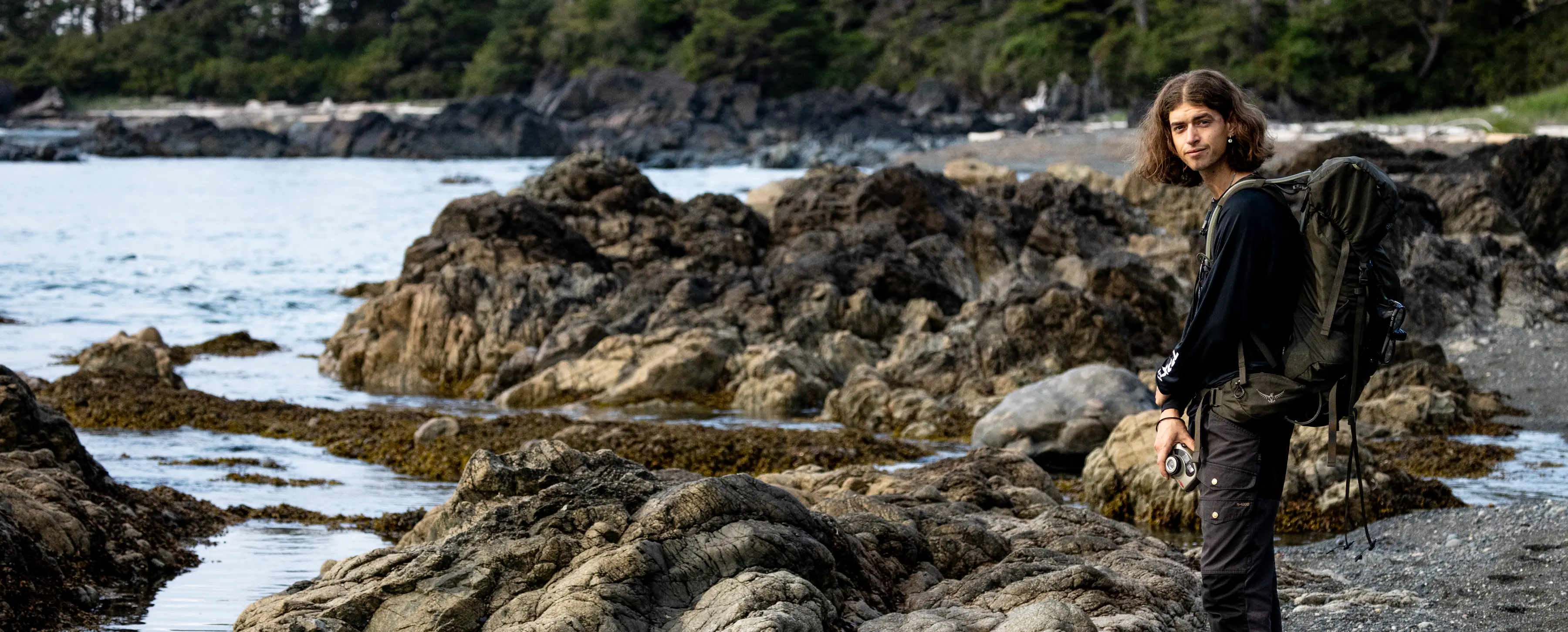
During his time at UVic, Anakin Bennett pursued opportunities across BC that blended biology, conservation and Indigenous-led stewardship. This included coordinating flood relief work in Secwépemc territories, conducting rare plant conservation in the Southern Gulf Islands and participating in research and ethnoecology field schools. Bennett focused his studies on land-based and community-driven approaches to ecology, conservation and stewardship.
Bennett, an Indigenous student connected to the Xʷsepsəm Esquimalt Nation, is graduating with a BSc in biology and environmental studies (co-op).
What moment or memory stands out most from your time at UVic?
After finishing my classes and stepping away from my role as an advocacy councillor with the Native Students Union (NSU), I was invited back to open this year’s Annual General Meeting with a welcome to the territory, which I did in Lək̓ʷáŋən. To my surprise, I was honoured with a blanketing ceremony, and many people spoke about the impact I made on their time at UVic. It was a deeply meaningful way to close that chapter and reminded me how much community shaped my time at UVic.
Where did you spend most of your time studying, hanging out or unwinding on campus?
I spent most of my time on campus at the First Peoples House. The ceremonial hall and shared student spaces encourage people to come together and routinely host cultural events, community meals and resource fairs. The Elders’ lounge offers a space to listen, learn and unwind. The House and the people inside became the heart of my campus experience.
Which course or instructor had a positive impact on your academic or personal growth?
I met biology professor Amanda Bates through a field school she taught at the Bamfield Marine Sciences Centre and worked in her lab during my final year. She encouraged out-of-the-box thinking and built my self-confidence as an academic and a professional. Her “failing forward” mindset and belief in students’ potential made it easier to take risks, experiment and grow without the fear of making mistakes.
What activity or experience outside the classroom meant the most to you?
The most meaningful experiences were when I got to work with Indigenous Elders, knowledge-keepers and professionals. These experiences offered a relational approach to learning that championed Indigenous sovereignty and community-led work. Being able to learn from and support Indigenous-led work firsthand was both inspiring and deeply impactful. It shaped how I understand my own role and responsibilities.
What are your plans for after graduation and is it the path you envisioned for yourself growing up?
Currently, I’m working with my community, the Xʷsépsəm Esquimalt Nation, in a youth advocacy role. I find it very fulfilling and impactful, especially seeing the direct benefits it brings to students and my community. My longer-term goal is to continue working with Indigenous communities, particularly in Indigenous-led conservation, stewardship and land-based approaches to caring for the land.
What would you tell someone who is considering choosing UVic for their degree?
UVic has a strong sense of community, amazing research opportunities and many supports for Indigenous students within a diverse and multicultural environment. One thing I’d share is that it can take time to find your community in Victoria. The Island lifestyle is also a big part of the experience. You really can ski in the mornings and surf in the afternoons.
What opportunities at UVic had the biggest impact on your professional development?
UVic offers so many awesome experiential learning opportunities, and I took full advantage of them. I participated in five field courses, four co-op terms, volunteering, networking events and Indigenous-focused programs like LE,NOṈET. These experiences helped me build practical skills in research, professionalism, communication, teamwork and working within community and field-based contexts.