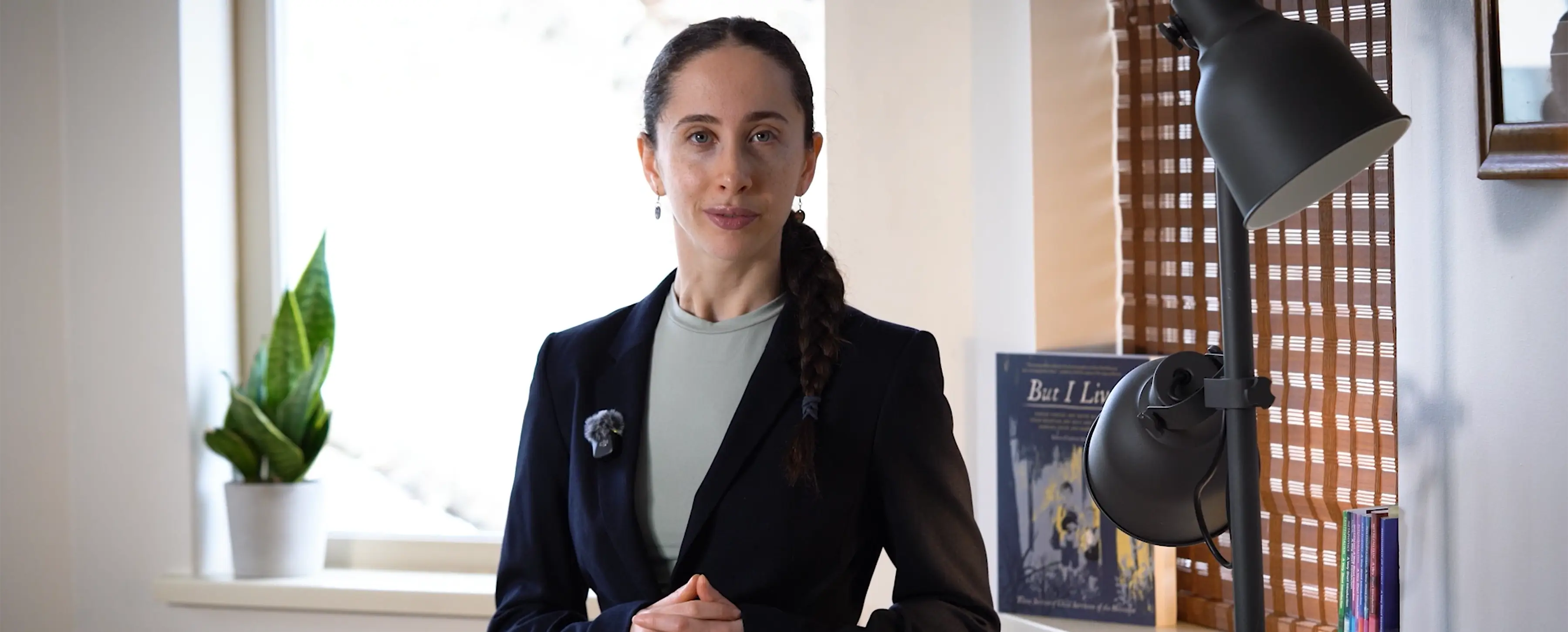
Ghada Youssef, a filmmaker and PhD candidate in philosophy, is combining her passions for film, dance and philosophy to platform crucial stories that challenge viewers to expand their perspectives. An experienced documentarian weaving political philosophy into creative practice, her interdisciplinary work explores how film can shape identity.
Philosophy of filmmaking
Youssef, who is from Lebanon, studied film for her undergraduate degree in her home country before moving to Victoria in 2022 to pursue her master’s in philosophy.
“I discovered my passion for film quite early during my teenage years, and I always knew that I wanted to become a filmmaker,” reflects Youssef. Along the way, she became interested in how philosophy intersects with film, and she now experiments with film, philosophy, and dance. Her PhD research explores, among other topics, how filmmakers are helping to shape Lebanese national identity. “I consider my studies in philosophy as a cornerstone to my filmmaking career.”
Survivor-centered storytelling
Youssef will travel to Montréal this June as one of 20 national finalists in the SSHRC Storytellers Challenge, where she’ll present her work to a live audience for a chance at the top spot.
The national competition asks postsecondary students to show Canadians, in up to three minutes or 300 words, how SSHRC-funded research is affecting our lives, our world and our future for the better.
Youssef’s entry is a short video that highlights the work of Survivor-Centred Visual Narratives (SCVN), a SSHRC-funded research project co-directed by Charlotte Schallie (Germanic Studies) and Andrea Webb (University of British Columbia), which honours the integrity of survivor voices from a wide range of genocides and mass atrocities in the global past and present. The SCVN project has created graphic novels and films sharing survivor voices from the Holocaust, Rwanda, Iraq/Syria, the Yugoslav Wars, and Turtle Island.

“The Survivor Centred Visual Narratives project was among my motivations to pursue doctoral studies,” says Youssef, whose supervisor, Cindy Holder (Philosophy) is on the project team and recommended Youssef for a research assistantship as part of her research funding for her PhD. “I was very excited that the project uses visual mediums to approach social justice topics—it felt like it sat squarely within what I’m already passionate about.”
As a research assistant to the SCVN communications team, Youssef is creating a filmmaker’s toolkit to solidify perspectives on making films in the context of genocide and mass atrocities, building on her interviews with SCVN filmmakers, her personal experience, and her ongoing research on philosophy and film.
Because she’s a visual person and a natural storyteller, Youssef knew she wanted to submit a video as soon as she heard about the Storytellers Challenge, envisioning exactly how she could pitch the project.
We live in dark times, and we are witnessing a genocide as we speak. Being exposed to the stories of survivors of genocide and mass atrocities is crucial to shaping a better-informed attitude toward these events. It gives me hope to know that people who lived those experiences have a platform for their voice to be heard. Sometimes, maybe most of the time, it’s all about hearing the right voice in the right way.”
—Ghada Youssef
In the meantime, Youssef hopes that participating in the competition raises the profile of the SCVN project. “It’s important, because I believe in this work,” she says. “If I know that one person got the curiosity to visit the website after seeing the video, then I’d be very satisfied!”